Author Archive
Tietiesbaai
By PG Jonker
[Published in Leisure Wheels, March 2011]
It’s always nice going back on your old tracks. One weekend we decide to follow my wife’s old tracks where they used to camp as kids at Tieties Bay. When they were small, long before the world discovered Tieties Bay, they used to camp there every summer holiday.
It is nice drive with the dirt road from Stompneus Bay to Paternoster. Paternoster used to be one of those secluded spots you would visit to get away from everyone. These days when you get there everyone is there already.
Downtown Paternoster is busy. Before you get the Paternoster hotel you drive past Oep vi Koep (Open for buy).

As expected, the local courtesy befalls us: any vehicle with a non-local registration number invariably gets an invitation along the lines of “Die Larnie willie ‘n kriefie koepie?” (Does the larnie want to buy a crayfish) Such a transactionwould, of course, be illegal. The appearance of a law enforcer evokes a quick recovery: “Nei, die Lanie niem net ‘n sneppie, nuh?” (No, the larnie is just taking a photo).
Downtown Paternoster is too busy for our liking. It is outside holiday season, so Tieties Bay should be deserted, guaranteed to render the expected splendour and quietness that we seek today.

Not so. Today Tieties Bay is just as busy as Paternoster itself. Some Inter Corporate Challenge sporting event is in full swing. Colour coded teams participate against each other. Rowing, cycling, that kind of stuff. We drive past all the action to where it is indeed quiet. We park the bakkie and walk off, away from the hustle and bustle.

My wife wants to go show me a cave where they used to play as kids. She relives the memories of big crayfish, waves and rocky pools to play in. She remembers this big pool where she used to swim as a four-year old. We find the pool. It is now 3 feet deep and 5 feet long. Maybe things look a bit bigger when you’re only 4 years old. My wife also shows me where the older girls would tan topless, and where the dudes would then peep over the rocks to watch the sun set.
Before we can reach the cave a guy with a huge camera comes running past us from behind. Then a whole team of participants in the Corporate Challenge also comes running past.

The next thing a chopper appears, with another camera man hanging out of the helicopter. Suddenly we find ourselves in something that feels like a reality show.

My cell pone rings. I answer, but cannot hear a thing. The rotor of the chopper makes one heck of a noise. Dust and foam from the water twirl up in the air.
Eventually things become quiet again. We reach the cave. The cave also turns out to be not as big as it used to be when my wife was 4 years old. In fact, it’s not really a cave, but rather a rocky overhang. Someone had a braai there recently. They did not clean up when they were done.
We can see that Jordan was there. As were Del and Carien. And Angel digs Reija, the grafitti on the rock confirms.
We sit down on a rock and enjoy the quiet.

Later we drive back. As one drive away from the sea you see the hill with the rock in the middle form which Tieties Bay got his name. It looks like a woman’s breast.

However, someone was not quite satisfied with mother nature’s endeavours, and decided to spice it up with something that makes the ‘nipple’ stand out more prominently.
Maybe it’s a good thing that the koppie was there before they built the lighthouse. The name might have been totally different then.

Paternoster’s beach remains a wonderful sight. 
Later the sporting event draws to a close on the beach, with flags, trucks, busses, sponsors’ advertisements, and plenty of people. A group of equestarians arrives from the opposite direction and meet up with there back-up team on the beach.
Paternoster has become a big town in comparison to what it used to be. It has become virtually impossible to take a picture without a “For Sale” bord somewhere in it. Guest houses abound.

I guess it’s progress. It’s good for the economy.
pgj
PG JONKER…
Stettyn
By PG Jonker
[Published in Leisure Wheels, March 2011]
One Saturday morning four families (including us) met at the Huguenot museum in Franschhoek, en route to Stettyn, via Villiersdorp, for a bit of 4 x4 and a sleep-over in nature, while putting our vehicles to the test at the same time.
Setting
From Franschhoek we travelled in convoy on the twisty road to Villiersdorp. The Stettyn 4×4 trail is located on the farm Stettyn between Villiersdorp and Worcester, at the foot of the Stettyn mountain range. The trail provides some nice challenges, we were told, and the views and terrain are magnificent, with a variety of fynbos and proteas.
Arriving at Stettyn, we found our way by following the directions to a nearby silo, which served as the admin building.

Inside the silo we signed ourselves in, unassisted.

On the walls inside the silo there are aerial pictures of the 4×4 route. They show the 12 hairpin bends you will encounter on your way up a climb that will take you 1300m above sea level.

Up, up and away
After a good brunch we deflated our tyres, and off we went.

It is a steep climb, and we travelled mostly in low range, second gear.

After an hour my bakkie’s temperature gauge started climbing too. We stopped a few times, but none of these stops made much of a difference to my bakkie’s temperature. The route is such that you cannot simply pull off and let the others pass. If you stop, no-one behind you can go anywhere!

So I kept going with the grumbling of the big six 3.4 litres in my ears, and the temperature steadily climbing (mine too).
Fans
I later switched the air-conditioning on, as this should activate the electric fan. However, after a short while I noticed matters were getting worse, so I switched the air-con off again. Eventually the temperature gauge got to the red line, when suddenly the temperature started dropping dramatically down to normal. I’m not sure whether it was because we entered the shadow of the mountain, or whether the viscous fan actually kicked in. If it was the latter, then it means that the viscous fan only kicks in once the needles starts nudging the upper limits of the temperature gauge.
I later found out that my electric fan had actually been burnt out and did not come on when I switched on the air-con. Which explains the rapid deterioration in temperature once I put the aircon on, instead of improving matters! I had to have this fan replaced afterwards, but I asked the auto electrician to add a toggle switch so that I could activate the electric fan without switching on the air conditioner. I’ve needed this device only once since, fortunately. That was in Chobe a few years later when I kept my bakkie running all the time because I was not sure how quickly an elephant could cover 50m! I also had the viscous fan replaced after the mechanic had the bakkie idling for a long time without any hint of the fan kicking in. So I’m still not sure whether it might actually have been working on the Stettyn trip, but only kicked in once the gauge reached the red line.
These days I’m not taking any chances. If that gauge just looks like its going up, I switch on my electric fan, simply because I have it.
Beating the bends
But back to the driving. Low range seems essential on this route. Steep inclines and rocky areas sometimes cause wheel spin that requires a diff lock to retain traction. At two of the hairpin bends the vehicles couldn’t turn, as there was not sufficient space, so we needed to do the bit that followed in reverse. At this spot, the Isuzu was coming up the incline, with the Toyota moving away from the camera – quite a classic scene, but you needed to be there to appreciate it.

The scenery was magnificent. The Brandvlei Dam could be seen in the background for kilometre upon kilometre.

Judging from the time display on my pictures, it seems that it took us some three hours (with stops) to reach the camping site 9km from the starting point. We eventually reached a point where we were able to look down at the campsite.

We made ourselves at home and enjoyed the facilities.

From the map in the silo office, we knew there was another campsite a further 3km away from where you can climb to the top and see Table Mountain in the distance. A rock cabin has been built there. However, we only went as far as the first campsite.
The camp site offered running water – from a tap and hosepipe, that is, apart from the stream running past the camp site.

A roofed area with cement floor and a low wall of about a meter high offered good shelter to kuier, with braai facilities. Proper ablution with donkey heated water also enhanced the experience to a very civilised level.

Stettyn is abundant with lovely varieties of fynbos. We didn’t see any animals, but were told that there are duikers and klipspringers and other antelope around. Leopards too, apparently, but we were not actively looking for one.

A game of touch rugby was set up with the ‘elderlies’ against the teenagers. It should be mentioned that the game was lost by the teenagers (rather than won by the ‘elderlies’), in spite of one of the ‘elderlies’ having been on his way to have a second hip replacement done!
By late afternoon the clouds had gathered around us, and by evening we found ourselves inside a cloud, leaving everything foggy and wet. Although it was not raining, everything got soaked.

This, of course, could not deter us from having the custumory braai the evening.
I was becoming slightly concerned about the weather. We left next morning in a thick mist (or was it a cloud?). For the first part of the return trip, visibility was severely restricted by the fog.

Whereas it had been very hot the previous day, it was now rather chilly, and in the conditions there was not much reason to stop.

The trip down, therefore, went somewhat quicker than the climb, but once again …
Beaverlac and Montagu
By PG Jonker
We had one of those extremely long weekends in May 2008. With a view on the upcoming tour to Vic Falls we were planning we decided it’s time for a trial run.
We were a party of three vehicles that hit the road to Beaverlac, just North East of Porterville. We took the back roads.

Just past (North of) Porterville is a worldwide renowned hang-gliding spot. For the benefit of the hang-gliders they tarred the little mountain pass.

It looks like nothing, but believe me it is nogal steep up there.
On top of the world.

In winter the land in the background become lush green wheat lands. Quite a sight then.
Some of the attractions at Beaverlac are the pools, and the foofy slide – hence the rope.

Of course we also did the camping thing, as was the purpose of the exercise.

At the fire:

We only stayed for one night, and thereafter left for Montagu. Due to a slight error in judgement we ventured into Montagu dorp on the Saturday morning.

Payday, Holiday, Easter, all compounded to make it a very busy morning.


At the end of the weekend we headed back home, and waited longer than a hour just to get through the Huguenot tunnel!
Nice weekend, though.
PGJ…
Cape Town Cable Car
Have mountain.

Want to go up the mountain. Now one can walk. But a disconcerting number of people that I read about in the papers that walk up Table Mountain have to be brought back in an emergency helicopter. Now I’m all for a flip in a chopper, but maybe not quite as a patient. So we opted for the cable car.

The waiting takes a while. At the lower cable station it was a quiet 26° Celcius. Some of the girls took the opportunity to get rid of (most of their) clothes and catch a tan. Sorry, no picture of that.
OK, mom, I’ll check out the route, you just relax.

Yeah, right.
Eventually we got on the cable car. Not to do if you are scared of people, confined places or heights.

Or, uhm, did I mention heights?

Better look up.

On terra firma again you can go walk about.
Robben Island viewed from above.

Table Bay

Le’me see, le’me see!

Now what’s the name of that movie again….?

Funny, it just does not look as charming from this angle.

PGJ…
Richtersveld Tour – Part 1
2001
By PG Jonker
[Adapted version hereof published in Leisure Wheels, February 2011]
PRELUDE
After returning from a Namibia tour where we drove up to Epupa with my Venture, I thought it a good idea to consider acquiring a 4×4. I had visions of me doing the great outdoors in my macho 4×4. I’ve since realised that I lack the nerve for that, but fortunately I write a lot better.
So I set off in search of a 4×4. I found one, but first had to sell my Venture. I turned out that, when I was looking to buy my Venture, everyone wanted one, and when I eventually tried to sell mine, nobody wanted it anymore!
When at last I sold my Venture, the 4×4 that I had identified was also sold in the meantime, but not to me. So the search for a 4×4 started afresh. Eventually I got an ex car rental Mazda Magnum DC 4×4.
So what now? Have 4×4, better get driving.
Frikkie solved the problem by suggesting a trip to the Richtersveld. Pieter and his family pitched in too, and off we went.

[Source: Map data ©2014 AfriGIS (Pty) Ltd, Google]
CAPE TO PORT NOLLOTH
After leaving Durbanville early in the morning we met up with Frikkie and his family at Vanrhynsdorp. Frikkie’s Hilux used to belong to a missionary outfit that travelled as far as Uganda with it. The elevated suspension gave the Hilux a real mean appearance. On Frikkie’s make shift roof carrier two bags of wood were evident, as well as the four legs of a steel frame chair protruding upwards. That was Frikkie’s home made porta potty. Pieter and his family would join us in the Richtersveld.
At McDougal’s Bay (Port Nolloth) we rented a house with garage. The reason for that was that I just had a burnt valve repaired on my brand new second hand bakkie, and the obligatory 1000km retorque had to be done. This Frikkie did before breakfast the next morning whereafter we departed for the Richtersveld.
PORT NOLLOTH – DE HOOP
We attended to a shop and a fuel station in Alexander Bay. At Alexander Bay we had to sign in at a security gate before entering the town. There was also a notice warning you that you might be requested to unpack your vehicle for inspection. Eish! Heaven forbid, given what our luggage looked like.
From there we travelled along the Orange River on a gravel road to Sendelingsdrift, the entrance to the Richtersveld. Not too far from Sendelingsdrift we turn off to have a look at the Wondergat. It is a hole some 40 meters deep. It was a rather nervous experience keeping the kids from not falling in. It’s not like it looks anything like Kimberley’s hole, but you might do battle getting out again once you have fallen in.
After attending to the formalities at Sendelingsdrift we were, at last, on a genuine 4×4 trip. My first. How cool is that, huh?
The first 7km or so were like an ordinary gravel road. From there it deteriorated initially to something similar to a farm road, and eventually to the point where the 4×4 functionality became very convenient, if not necessary. This was great fun.
Progress was hampered when one steep incline on the road caused Frikkie’s roof rack to partially slide off the roof and first had to be fixed. But fixing stuff is mos Frikkie’s thing.
Here we also see the first halfmense grow. Being stingy with my pre-digital era photos I kept holding out for a better halfmens until eventually, I left the Richtersveld without a picture of a single one! After a leisurely 43 km drive we reached De Hoop.
We found quite a number of people camping there. There were, however, quite a few kilometres of river sites from which we could pick our site. We made camp right on the bank of the river.
DE HOOP
At De Hoop the river runs in a Northerly direction. Because of mountains on both side of the river, the sunrises and sunsets are maybe not so spectacular. However, in the evenings the sun reflects orange on the river from the mountains on the Namibian side of the river.

We enjoyed a leisurely day. It was one of the kids’ birthday. Undeterred by our environment we had a birthday party, complete with a pot bread-cake and surprise packets for each kid.
The arrangements for sanitation were less than desirable. [I understand this problem has since been attended to by the Parks authorities.] It’s OK finding your spot and marking it to prevent others from having a close encounter of the fourth kind, but the following week’s visitors might not necessarily be fortunate enough to enjoy the same benefit.
Frikkie’s home made porta potty earned its keep.

I also utilised this invention on occasion. In my private little spot I became aware of a commotion in one of the trees. A bunch of little apes were sitting in a row on an overhanging branch, watching me intently and chattering amongst them. I’m sure I heard the one say: “Hey, check that larnie toilet, ek sê.” I might be mistaken, though.
Between the three families we brought along 150 litres of drinking water, but ended up using the water from the Orange River after boiling it before use for human consumption.
Two of the boys spent hours trying to catch fish. The piece of washing line and bent nail utilised for this purpose, however, turned out to be unsuccessful. However, “success” is a matter of opinion. Keeping two boys out of mischief for hours on end in my book actually counts for a great success.

TATASRIVIER / RICHTERSBERG
From De Hoop to the Tatas River picnic site there is a “road” of some 10km’s. There is also a 45km detour. After a bit of planning, we (well, some of us) opted for the more challenging shortcut.
This road is very powdery sand causing impressive dust clouds as far as we went. It took half an hour to do the first 6km’s, where we stopped at a derelict fridge. It seemed like a left over from one of the many prospecting locations of earlier years.
The remaining 4 km’s also took about another …
Richtersveld – Part 2
By PG Jonker
DE HOOP – DE TOON
After two nights at De Hoop we departed for De Toon, 71km’s away. The route takes us through the Domorog pass. The road is narrow and steep with low range necessary. Or so we thought. When we got to the bottom of the pass a local farmer was waiting for us to pass so that he can drive up the pass with his ordinary Toyota bakkie. He explained that “with a bit of IQ” one can do it without 4×4 or low range.

Point taken, but I’m not sure how long such a 2×4 vehicle’s clutch and brakes could last.
We reached Springbok plain where the road stopped in the middle of nowhere, with a notice indicating the terrain beyond as being forbidden terrain.

From there we travel to Kokerboomkloof, past De Toon (the Toe), or also known as Eierkop (Egg head), due to the shape of the rock formation.

Here we also visit the Drumsticks rock formation.


Right opposite the Drumsticks there is another rock formation that looks like a turkey, watching over your shoulder.

At Kokerboomkloof we made camp. The name comes from the great many Quiver trees to be found there.

This time I took a few pictures of the Quiver trees, so as not to end up the way I did without a picture of the Halfmense.

DE TOON – PEACE OF PARADISE

[Source: Map data ©2014 AfriGIS (Pty) Ltd, Google]
We left De Toon early for the Helskloof gate, 71km’s away. We pass De Koei (The Cow) camping site. It did not strike us as very inspiring, and there were no-one there.
We left the Park at the Helskloof gate and headed for Peace of Paradise, next to the Orange River, but more East, nearer to Noordoewer. We visited Khubus.

We then passed through Eksteensfontein.
Just as we came out of the Helskloof pass Frikkie’s Hilux lost its rear right wheel with the half shaft being pushed out of the differential.

Four hours later Frikkie had the wheel fixed, and we were on our way again.
Peace of Paradise was a wonderful bit of paradise. Sadly it apparently burnt down a few years later and was not rebuilt. Amazing how exciting people can be about flushing toilets after only a few days without it.
PEACE OF PARADISE – HOME
We set off from Peace of Paradise with Frikkie dictating the pace with the Hilux. Only a few kilometers away he saw that the rear wheel was again starting to push to the outside. After making enquiries as to the availability of a mechanic we (erroneously) ended up at the plot of Oom Hendrik van Zyl. Oom Hendrik happened to be a retired mechanic and auto electrician who used to do field repairs on Spoornet vehicles. Oom Hendrik had every tool necessary, and with the assistance of his son Christo the bakkie was back on the road in no time.

It turned out that Frikkie did everything right the previous night, but for the fact that he did not have a circlip that was necessary to finish the job. Oom Hendrik also did not have one, but he had a spring that he used to cut out a circlip. And off we went.
Frikke and we travelled in convoy, south bound on the N7. As Frikkie’s confidence in the final repairs of his wheel increased so did his speed until we did a handsome 90km/h.
In the meantime Pieter and his family had to leave to meet a deadline at home and was travelling ahead. However, their drive home came to an abrupt end with a head on collision with a Colt bakkie in the Piekenierskloof pass.

As Pieter came to a standstill the Nissan Sentra behind him also collided with him. After pausing a second or two to make sure there were no further collisions Pieter and Hanneke and their young son got out and put some distance between them and the stricken bakkie – very much aware of the full fuel tankd and jerry can on his roof rack. Fortunately no further calamities befell them or the vehicle.
By 19h00 that evening Frikkie and us made it to Vanrhynsdorp from where they headed for friends at Vredendal. An hour later we checked on Pieter and Hanneke at a guest house in Citrusdal before heading home.
Just past midnight we hit our beds in Durbanville.
TOUR STATISTICS:
Distance done: 2050 km
Petrol used: 307liters
Vehicle: 1998 Mazda Magnum DC 4×4
Engine: 3.4 liter V6 petrol
Power: 108kW @ 4800 rpm
Torque: 267Nm @ 2800 rpm
Fuel consumption for trip:
Average: 6,7 km / litre (14,9l/100km)
Worst: 4,8 km/l (4×4) (20,8l/100km)
Best: 8,7 km/l (11,5l/100km)
Nights out: 7 (1 x Port Nolloth, 5 x Richtersveld, 1 x Peace of Paradise)
Tent pitched: 3 times
Water used: 90 litres of drinking water over 5 days between 7 adults and 5 kids (and an estimated further 450liters of river water for washing and dishes)
PGJ…
Kgalagadi tour
By PG Jonker
Background
In 1999 I took the family for a tour to the Kgalagadi Game Reserve. I took my mother-in-law along too. I thought it might be a good idea to introduce her to the renowned Kgalagadi lions, if you catch my drift. However, we did not see a single lion, and my mother-in-law is still around. Four years later we did the tour again, this time without my mother-in-law, as by then we had a third kiddo on the back seat.
The first item that we packed this time was a 25 liter can of water. It is amazing the thirst that takes hold of you the moment you realize that the salty water is not drinkable. Then, suddenly, you don’t want a soda. No, then you want pure, clear water!
My wife read somewhere that it is a good idea to take play balls along on a trip like this. It is good for the kids. So she duly complied. At Vanrhynsdorp, exactly 301km’s away from home, we make our first stop at the fuel station, took out our breakfast, and played ball. However, if you are only 19 months old you don’t always grasp the rules of the game. So the moment he saw a ball rolling, Chris-Jan would give chase, confiscate the ball whilst shouting “ballie, ballie, ballie,” and then refuse anyone access to said ball.
We travelled through Calvinia with its massive post box, but decided to take the ‘been there dunnit’ picture on our return trip. Sadly, I have to report that we neglected to do that on the way back as well.
At Brandvlei we stopped for petrol, and had lunch at Die Windpomp restaurant, adjacent to the Boesmanland Instap. The menu at Die Windpomp boasted that it was the best pump in town……

Due to a power failure we could not get the Full Monty, but nevertheless had an extremely decent meal of hamburgers and coffee. You can catch my wife and me in a trap with good coffee.
From here we travelled further to the North. This is Boesmanland. It is a harsh world and I have endless respect for the farmers who make a living here. There are very few cars on the road, which might not be a bad thing, because the occupants of every single car greet you as they drive past.
We drove through Kenhardt (it looks a bit like Brandvlei, I thought), with Keimoes the next town. What a beautiful green place. And just as you think you have passed through the dorp, there is a board that says: “Keimoes 4km”.
At Upington we rented a bungalow in Die Eiland holiday resort. With the sun setting our son, then 11 years old, came to call us very excited to come and see the fairy. Amazing. I did not know fairies existed anymore. It turned out, though that he meant the ferry that does sundowner trips from the Upington hotel, which is just across the river from Die Eiland. But it was a fair mistake, I’d say. With all the lights on the ferry one could easily mistake it for a fairy.
After we had all the kids clean and ready for bed we found exhibit “A” in the bath, that clearly indicated that the youngest of our kids did somewhat more than just passed a flatulent in the tub.
Last leg to Kgalagadi
The next day we hit the road for the last 255km’s to the Kgalagadi. The last about 80km’s was extremely bad corrugated gravel road. I understand this road has since been tarred. It was a relief to reach the gate at Tweerivieren (Two Rivers).
Reporting at the office with 19-months old Chris-Jan was rather entertaining. Against the walls there were a number of pictures of Kgalagadi lions. Chris-Jan would storm up to the picture and shout: “It’s a ‘whau!’”.

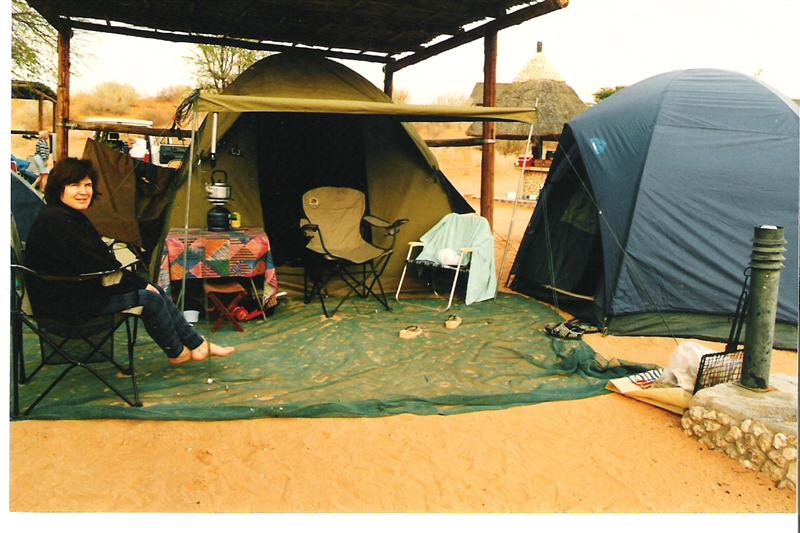
Having had our trial run with our new camping equipment on our Calitzdorp trip, we managed to pitch our tents without much of a problem. After setting up camp at the Tweerivieren camp site we went for a drive.
It is my pleasure to inform you that Springbok, Blouwildebees and Gemsbok (Oryx) are not extinct species.
We arrive back at the camp just before sunset. An errant little sand storm came past, leaving everything under sand. Then the clouds started stacking up against the horizon until we eventually had a wonderful performance of a thunder storm. The bolts of lightning would light up the skies, pretty much like daylight. You would have been able to read your newspaper. Admittedly, you would have had to do it fast. Then the rain came. Not much, just enough to leave everything fresh and wet.
The next day our older kids found the swimming pool. There they entertained everyone who wanted to look, and also everyone who were involuntarily exposed to their performance, to 99 ways how to fall in the water.

From our camping site we had an unrestricted view of the entrance gate to the Park. It made for some interesting observations watching new guests arriving, especially those doing so with sedan cars, rather than with bakkies or commercial type of vehicles. Invariably the driver (who has now just finished what could possibly be the worst bit of gravel road he has ever travelled on) would get out, walk to his rear wheel, and upon finding it to still be in place, give it a kick just to be sure his eyes are not playing parts with him, before trundling off to the entrance gate.
That evening we had ostrich meat and Karoo lamb on the fire. The Karoo lamb tasted like a dream. The ostrich meat…. well, nothing good comes to mind. We later realised that we did not have the ostrich properly done yet. Clearly we are not rare ostrich meat enthusiasts. That evening it was so quiet we could sit back and have a dinner outside at candle light.
It is interesting how the days can just rush past without you seemingly having done anything when you are camping. Not that it is a bad thing. After all, you are on holiday, intent on doing as little as possible.
The next afternoon two trucks with German overlanders …
Trunk Call
By Johnie Jonker
Elecam
In April 2001 the South African Natural History Unit (SANHU) released a wildlife TV film commissioned by Discovery Channel International, Animal Planet and HIT Entertainment. The press release read as follows:
Described as one of the most exciting natural history shows ever seen on television, ‘Ele Tele’ offers 50 minutes of sensational viewing from the unbelievably exciting personal perspective of a mature African elephant cow as she ranges through South Africa’s Addo Elephant National Park.In a world-first, SANHU filmed the footage for the programme using a specially-designed camera and microphone rig (called the EleCam), attached to a collar worn by Afslurpie – an elephant specifically selected for the project by South African National Parks (SANP). Since the EleCam was controlled remotely, there was no film crew close to the elephant or her family. As a result, the recorded footage – filmed between mid-January and mid-February this year – reflects the uninhibited behaviour of elephants in the wild and has provided revelatory information for scientists about elephant behavioural patterns.
Not covered by the film, however, was the learning curve which commenced exactly a year earlier, leading up to the (eventual) successful shooting of this footage. The following is an attempt to relate these events as an eyewitness report.
Start
The original camera was contracted to a UK company who installed a radio controlled zoom camera with video transmitter inside an enclosure, to be mounted on a collar attached around the elephant’s neck.
As my employer at the time did the maintenance on the Route 66 helicopter camera equipment – which provided aerial footage for the project – we were known as having some experience in the design of cameras, and the Elecam was brought to us for comment.

It was immediately clear that the designers knew only the first thing about elephants – that they were big – hence the camera did not have to be “discreet”. They did not realise that elephants also:
- Swim, with only the “periscope” up
- Squirt themselves (often!) with muddy water and dust
- Although not that fast, have LOTS of momentum when crashing through trees
- Are intelligent and inquisitive
to name the immediately obvious ones.
Although dirt obscuration was anticipated to be a problem and the prototype camera was equipped with a window washer, the tank capacity was inadequate. It was however decided to use it as is for the initial testing in the Kruger National Park – but of course with the hope that it would be successful and sufficient to complete the program first time round.
The Journey
The adventure started one rainy day in January 2000. This was not just any rainy day, but was the early stages of the flood period remembered for Rosita Pedro, the Mozambican baby, born in a tree. The helicopter that picked us up in Centurion was loaded to capacity and we v-e-r-y slowly gained height on our way to Skukuza. The weather report indicated that the cloud base was too low to get over the Drakensberg under VFR (Visual Flight Rule) conditions, and the pilot therefore headed for Haenertsburg, flying in driving rain all the way. When we reached the outskirts of the township, the streets were muddy rivulets, and the helicopter was brought to a hover to assimilate the situation. It was almost surrealistic the way the collective pitch lever between the two front seats were pulled up like the handbrake of a car, as if at an intersection, Piet Otto slowly rotating the helicopter to pick the best route. This turned out to be down the Olifants River Valley, and what a ride!
All the passengers were on look-out duty for cables strung across the river by the locals, used to transfer their possessions and gatherings from one side to the other – we were that low. Having spent many hours in helicopters prior to this, it was unusual to have most of the environment above and around, rather than below, as is the norm.
We broke cover as the gorge opens up at the bottom of the Abel Erasmus pass and from there had a clear run via Hoedspruit to our destination.
The Equipment
As the video image was to be transmitted live from the camera, a receiving point was required. This was provided by the SAPS Air Wing in the form of a loan mobile receiving station. This consisted of a trailer resembling a horse-box, with a pneumatic mast with an omni-directional antenna on top which could be extended to 30m, providing good reception coverage. This system is normally used by the Air Wing as receiving station for the stabilized cameras they have on their helicopters.

As the transmission frequency was dependent on line-of-sight between transmitter and receiver being maintained (pretty much like the signal between a cell phone and the nearest tower), the terrain where it was set up was also chosen to be relatively even, so that the signal would not be obscured by tall geographical features.

This MGRS (Mobile Ground Receiving Station) was hauled along from the Johan Coetzee SAPS Airwing HQ in Pretoria to Skukuza by SANHU, where we camped – within the staff village – for the duration of the trials.

The Process
The procedure was planned to be executed as follows:
- The chosen elephant would be separated from the herd by cutting it off with the Route 66 helicopter

- The elephant would then be darted from the helicopter after rounding it up to a location as close as possible to where the ground crew was waiting on one of the “no entry” roads
- Next, the collar would be installed. This consisted of a wide synthetic strap with the camera in the centre, and the two ends going round to below the elephant’s neck, attached to a car battery in a box. The battery provided both 12V power to the camera and served as counter-balance to retain the camera position central to the head of the elephant.
- Conservation personnel would be in continuous attendance and monitor the vital signs of the elephant. One of their activities would be to apply water to the inside of the elephant’s ears as coolant, as these are an elephant’s radiators. Due to the flapping action required to make it work, this cooling function would now be absent.
The saving of Sam
By Johnie Jonker
Sam was my 8-year old medium-sized cross-breed dog which was given to me by my future wife a few months into our relationship.
A mostly black – with tan details – superbly intelligent, enthusiastic, energetic, loyal family dog. Endless entertainment for my two young sons. In fact, we seem to recall that my oldest son – almost 5 at the time of the events described below – Jacobus’ first words were not Mamma or Pappa, but Saaa..!, Saaa…!, toddling around the yard looking for the dog. His next word was Tee….taa! (tea-time – this he learnt from his grandfather) when he was thirsty. But I digress.
Prior to leaving for Norway as technical support for a tracking camera system used at the speed-skating and ski-jumping venues of the 1994 Winter Olympic Games, the sliding gate at home packed up and was stuck in the open position. Sam was standing inside the drive-way, when the neighbour from across the street’s Staffordshire terrier managed to slip out their gate, came over and attacked him, in the process breaking both bones of his left front lower leg.
We had spent quite a bit of money on vet bills – reasonably beyond the point where most people would have had their pet put down – trying to get the leg fixed, but Sam kept on eating the plaster-of-Paris off in order to get to the itch. We had given up hope on the leg healing due to the persistent infection, and were considering whether the leg should be amputated or perhaps even the dog put down as a cheaper option. These were some of the thoughts I left home with.
Back to Norway. On the days when there were no speed-skating events in Hamar, we were free to travel on the official buses which continuously commuted between the various Olympic villages from 4 am to 12pm daily. In this way we (the rest of the UK/American camera crew and me) got to do quite a bit of sightseeing in terms of events. Our accreditation IDs – hanging around our necks – allowed access to all the other venues. As Lillehammer was the main village, and also where the company – Aerial Camera Systems – which contracted my services were stationed, I went there a number of times.
On one of these occasions I was up at the ski-jumping arena, where the opening ceremony also took place and where rehearsals for the closing ceremony were presently under way. One of the events were going to be the entry of the Olympic mascots – two kids named Haakon and Kristin, doll-children from Norwegian folklore – on a sled pulled by a team of huskies.
The dogs were quite unruly and keen to run, almost to the point of destruction, and were howling away, tugging at the reins. As I stood there watching this I suddenly burst out crying uncontrollably. At first I thought maybe I was just homesick – I had been away for three weeks now, and it would take another three weeks before I got back – but once I could think clearly, I realized what it was.
That evening when I got back to Hamar – normally I’m too stingy to phone, I rather write emails – I phoned my wife and told her that whatever the cost, we must save Sam’s leg.
She wanted to know how I came to this decision. I said:”The huskies told me”.
JJJ…
Hundred Million Rands
But for you, my friend, we make it Pounds Sterling
By JJ Jonker
Yes, that would be my net worth if I claimed some of the lottery wins of which I have been notified during the month of August. Being from a Calvinistic background however, I knew that all this money would corrupt me, and therefore opted out. It is however fascinating how widely one can amass money without even entering a lottery. All you need to do is send an email. This automatically enters you for the draw.
Exactly the opposite of the faithful Christian, who one day started complaining bitterly to God that in his experience, the power of prayer is a myth. This because he had been faithfully praying every night – since it’s inception – to win the Lotto. But to date, he has not even won any of the smaller, “3-correct number” prizes. A voice from above then responded as follows: “Please help me out here and at least buy a ticket”.
To prove that I am not making this up, I attach a summary of (some) of my winnings for August:

I can declare solidarity with those intrepid astronomers of way back when they first realised the earth was not flat or that it was not the centre of the universe. Should they tell anyone?
The above results – multiple lottery wins on the same day, TWICE in one month – proves beyond a single thread of doubt that statistics and probabilities as we know it today, is complete hogwash.
In addition to the above wins, I have also been named the beneficiary of – amongst others – a USD4.5 million estate, should I claim to be the relative of one “Mr Andre Deek, who died in a terrible hot air balloon crash that also took the lives of two other innocent souls”. Barrister Ben Mnpapati from the Eenin Republic (could not find this on Google) goes on to say that: “All I require is your honest co-operation ….”
By these persistent attempts to separate me – and no doubt many others – from my money, I question the truth of the saying: “There’s a sucker born every minute”. No, it has to be more frequent than this, say every 5 seconds?
The background to these scams is usually well researched, and built around commonly known facts, e.g. the existence of the organization allocating/enquiring about any issue. Below is such an example, banking on the greed and gullibility of the human species. The highlighting indicating the hooks and their explanation is mine.
This is a confidential message (there we go, I am the only person to receive this) from IEFM Private Equity and financial Consultants.
We are conducting a standard process investigation on behalf of HSBC private bank (Yes, I’ve heard of them, they also sponsor Gran Prix motor racing), the private banking arm of the international banking conglomerate (Right again. Their head office is in Canada).
This investigation involves a client who shares the same surname (what a coincidence!) with you and also the circumstances surrounding investments made by this client at HSBC Private.
The client died in intestate (ag shame) and nominated no successor in title over the investments made with the bank. The essence of this communication with you is to request you (to) provide us (with) information/comments (sure, what harm can this do?) on any or all of the issues:
1-Are you aware of any relative/relation who shares your same name who’s last known contact address was Madrid, Spain?
2-Are you aware of any investment of considerable value made by such a person at the Private Banking Division of HSBC Bank PLC?
3-Can you establish beyond reasonable doubt your eligibility to assume status of successor (my goodness, what a stroke of luck!) in title to the deceased?
It is pertinent that you inform us ASAP whether or not you are familiar with this personality (so) that we may put an end to this communication with you and our nquiries (spelling mistake) surrounding this personality (not quite the Queen’s English).
You must appreciate that we are constrained (yes, of course I understand – banks can’t divulge personal details of clients to ANY outsider, related or not) from providing you with more detailed information at this point. Please respond to this mail as soon as possible to afford us the opportunity to close this investigation (I’m going to do so straight away).
Thank you for accommodating our enquiry (nice, civil people).
If you share my surname – or any other should also work – you are welcome to take up this offer on my behalf by contacting Paula at the address below.
Paula Aguilar (nice Spanish name – where have I heard it before? A singer, perhaps?) Email: iefm@w.cn
Just imagine if the scammer put this effort into a real job – say journalism – what career heights could be achieved.
However, invariably, these letters contain poor grammar, spelling mistakes (possibly from a Nigerian dictionary) no official letterhead, and if so, a poorly scanned logo from e.g. a bank, which is easily detected due to its low resolution.
Although the example above has a name, these often sound fake, almost as if a computer generated it by taking a random name from one list and combining it with a surname from a second list, or quite often the combination of two surnames. Here are some examples:
Mr Haruna Sule, The Camelot Group on behalf of the UK Lottery, Mr Mohammad Noiraat from Sudan – presently residing in Kwazulu Natal and Morris Camara with the same details, George Garang (and others) from Stantanders Bank, London (no, this how they spell it), Mrs Selena Gomez Smith from (also) the UK National Lottery Commission.
Here’s one from a person who would like to know me better:
Hi, Good day, my name is Miss Stephanie 26yrs single girl, from Sierra Leone in West Africa. Presently residing in Ouagadougou (Burkina Faso) I will love to know you. Upon your reply I will tell you more about myself and send you my picture.
Love Stephanie
What a lovely letter. Not asking for any money. I like the girl already. It sounds like the type PG attracts.
Some offerings are of course more blatant right from the start, directly …