Author Archive
EMC
By Johnie Jonker
Electro-Magnetic Compatibility, or rather, in this case, Incompatibility.
Well, what does this mean? Ever notice the CE, GS, TUV or any of a host of other markings on amongst other, portable electronic devices? It’s on your laptop power supply, your cell-phone charger, the food mixer, etc. These are international safety standards to which the various devices comply and (should) have been tested to, which means, amongst others, that when turning on one device, it will not electronically interfere with another, being compatible with it.
So if your wife switches on her hair drier, the TV picture does not go skew. Or Uncle Phil’s cardioverter-defibrillator (ok then, pacemaker) does not attack him. A necessary safe-guard, it would seem.
Of course cars, also being highly electronicised these days, have to comply with similar requirements. However…
Regular exercisers will be familiar with heart rate monitors, such as the Polar 610i.
These HRMs work in conjunction with a chest strap, transmitting the wearer’s heart rate at periodic intervals. The signal is of an electromagnetic nature and picked up by the wrist receiver or gym treadmill. The data can then be displayed and/or recorded in real time for an instant indication of effort, and also allow PC download and analysis at a later stage.
The basic formula for maximum heart rate is calculated by the HRM as 220 minus your age, so in my case a heart rate of 168 beats per minute should be achievable prior to being carried out on a stretcher.
I have however found a way to achieve even better heart rates without going to the gym at all. How, you may well ask – by sitting in my car. And no, not road-rage related.
Getting into the car with a heart rate of sub – 60 bpm, the moment the ignition is switched on, the indication revs up to 210 – 230 bpm, the abundance of electromagnetic interference flying around in the cabin totally swamping the Wearlink signal.
Now, if the over-reading was just a bit more realistic, say 85% of the max heart rate, one could (ab?)use it to effortlessly exercise and earn points through Vitality. “I’m going to the gym, dear”, would take on a whole new meaning: sitting in your car in the garage at home for 30 minutes, listening to some relaxing music, having a beer and a really good chill. But no, trust the car manufacturer to go and completely overdo it!
I am sure that at least some readers would agree that the above type of exercising may actually prove to be more beneficial to their health than a strenuous work-out at the gym. Yes?….No?
But back to matters automotive: If a local motoring magazine were to publish this information, I guess it would be under their “Leisure Heels” section.
This may also well be a world first and the dawn of a new era in terms of automotive advertising: “Go Green! Buy our new model, and communicate with the dolphins and whales!
Being bombarded with such an unseen force from within, I have become wary about possible, even bigger, forces from without. So when I’m on my way to the gym wearing the HRM, one of my “pre-flight” checks prior to departing from home, is to ensure that the sunroof is CLOSED, for fear of being beamed up by Scotty.
JJJ…
TO HELL AND BACK
By PG Jonker
How it happened
Over a cup of coffee Pieter let it slip that he had a caravan site booked at the Calitzdorp Spa. I did not know that Calitzdorp had a Spa. Actually, I did not even know where Calitzdorp was. Nevertheless, I then promptly booked a site for my family as well. After all, we had a brand new second hand tent that had to be taken for a test drive.
Packing
Packing for a tour is not per definition ‘touring’. However, in this case the packing requires some comments. See, this new tent of ours was a rip stop dome with a “diner / extension”. Apart from the day that I took delivery of it and pitched it just to check that everything was there, this tent had not been camping with us before.
Given the size of the tent with extension, though, it was clear from the outset that there would not be space for our fold out mattresses. In fact, there would not even be space for the “diner / extension” if we do not take a trailer along which we did not have. Out of curiosity I weighed the equipment, only to find that the whole package weighed a cool 70kg’s!
Standing back to inspect after packing our stuff the Friday evening before our departure, it appeared that I might, with a bit of rescheduling, get that diner/extension in as well. So the packing started all over again. Everything had to come out of the double cab again. Rather proud of myself I managed to get the complete tent with the extension in. After all, the whole idea was to see if we could get this right before the upcoming tour to the Kgalagadi Park a few months later. All that remained was that “last few things” that comes in the morning of our departure. Experience have taught me, though, that this “last few things” often gets very near to breaking the camel’s back!
Calitzdorp spa
We departed early Saturday morning. Twice. At Kraaifontein, about 10km’s away from home, we had to turn around the switch off an electrical appliance. The second attempt was more successful.
Calitzdorp is far from Durbanville, especially if you later find that your eyes have become watery because of a need to visit the restroom. To make matters worse, the road signs did not play along at all. By the time we should have reached Calitzdorp, the road sign said it was still 10km’s away. When we eventually reached Calitzdorp, we learnt that the Spa was still 20km’s off. And when we eventually reached the turnoff to the Spa, there was yet another sign indicating the Spa to be still 7km’s away! Paah! Eventually, though, we got there.
Pitching tent
It took a while to pitch the tent. Quite a while. No. Let me rephrase. It took a ^&*($@# long time! By the time the last tent peg was in, it was 15h00 – just in time to go find a TV to watch the Tri-Nations rugby test between South Africa and Australia. The test, I am happy to report, was won by South Africa, albeit with a small margin.
It was a wonderfully quiet full moon night. However, by 21h00 one got the feeling that your denims are just too cold against your skin for comfort. Pieter warned that it became rather chilly the previous night – they came a day earlier. Now how cold exactly, we asked. Quite cold, reckoned Pieter.
It turned out to be -1 ° Celsius. Cold, man. Like in Kimberley-in-the-army-in-winter kind of cold. Eish! You can put more clothes on, but it only prolonged the process of the cold eventually getting into your bones – it cannot prevent it. This is not, let me tell you, my idea of camping.
During the course of the night my wife did her rendition of Racheltjie de Beer , checking on the kids every now and then to see if everyone is still alive. And every time she finds yet another garment from a bag to throw over us. By 05h00 the next morning we were fighting against the awake. We did notice to our relief that and could not be too long before the sun would be out.
Swartberg
Getting started – literally
Sunday morning eventually broke. The plan was to go over the Swartbergpas [‘Black Mountain pass”] and to visit Die Hel. [“The Hell”]. But first we needed to get the kids out of bed.
Some of them were crying because it was so cold. I could relate to that – I pretty much felt the same. Everything in your body hurts because of the cold. The windscreen of the Mazda was frosted up. I chose not to use warm water to improve things for fear of cracking the windscreen. So I decided to rather get the engine running and to drive through the caravan park whilst getting the heater to defrost the windscreen. However, because of the cold the remote control would not work. So I had to unlock the door with the key. As expected, the quietness of the early Sunday morning was shattered by the wailing of the alarm. It took a while to get that deactivated.
Because of the fact that the choke of the bakkie [for those not from SA, a bakkie is a light pick-up truck, or a utility vehicle in Ozz] was giving me problems, I had that made inactive some time before. I will not take you through the process, but suffice to say that it took some convincing to get that 3.4 litre petrol engine started without a choke in sub zero temperatures.
I took Chris-Jan, then 17 months old then, with me in the bakkie. At least it was mos supposed to be warmer inside the bakkie than outside. Not so. With the frost on the windscreen I had no choice but to wind down the window and hang out of the window to see where I was going. So, whereas in theory it was supposed to be nice and warm inside, it took an inordinately long time before that point was reached. In the meantime Chris-Jan and I had to contend with what I believe the weather station …
West Coast Tour – Gallery [1]
First Stop: Langebaan

[Source: Map data ©2014 AfriGIS (Pty) Ltd, Google]
At Mykonos yacht club.

Kite surfers on the beach

Saldanha
Just around the bay to Saldanha. A panoramic view from the koppie overlooking the bay. If you know what to look for you can see Mykonos in the middle in the background.

Jacobs Bay

Jacobsbaai hotel

Swartriet
Walking distance away from the Jacobs Bay hotel

Paternoster
Paternoster beach

Shopping at Paternoster

Tietiesbaai
Where Tietiesbaai got its name from

Camping at Tieties Bay

Cape Columbine lighthouse
 …
…
West Coast Tour – Gallery [2]
Stompneusbaai / St Helenabaai

[Source: Map data ©2014 AfriGIS (Pty) Ltd, Google]
Stompneus Bay

Shopping at Stompneus Bay

Mid-West, St Helena Bay

Sandy Point Harbour

Velddrif
The bridge over the Berg river


Port Owen in Laaiplek

Dwarskersbos

Rocher pans

Elandsbaai
Elandsbaai hotel
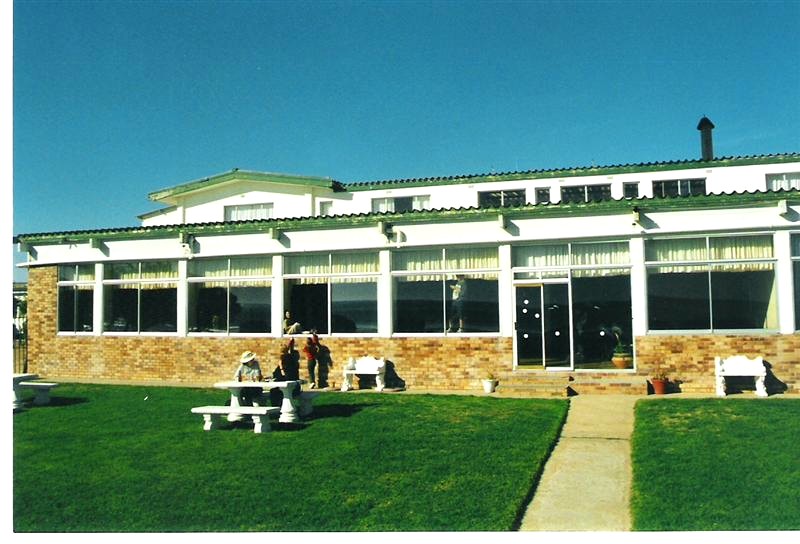
Lambert’s Bay
Harbour

Bird hide

Gannets

Side walk cafe – Isabella’s
 …
…
Are you ready, Steve?
One day, I want to play in a band. It only need to be once. But I want to be the guy with the microphone. And there must be a guy in the band whose name is “Steve”. See, I want to call over my shoulder: “Are you ready, Steve?”
In the seventies my brother had an LP (for the X-generation: a Long Player, a vinyl, a record; that funny round black thing that you put a needle on and turn it around and then it makes music, OK?). On this LP there was this song that started like that. I can’t remember the song, really, only the intro. But it fascinated me. The leader of the band calls over his shoulder to Steve. But Steve does not talk. He just goes crazy with a drum roll. And then the next thing, you had the music. Cool, man.
It’s one of those iconic moments for me. You know, similar to where Clint Eastwood says: “Do it, make my day,” in the movie Sudden Impact. Or Clark Gable’s “Frankly my dear, I don’t give a damn,” in Gone with the Wind. I’ve always been looking for a good opportunity to use these two phrases, but I’m rather careful how to use it, you know what I’m saying.
Anyway, back to Steve. I was too young to know who the band was. But bro’ Johnie is 5 years older and a bit of a music nut. It was The Sweet’s Ballroom Blitz, he advises.
It’s been a while since I’ve heard ol’ Steve. Time for a bit of fresh inspiration, methinks.
PGJ…
Robbery
By PG Jonker
Thomas* came from Zimbabwe. There was a time when his fortunes were better. He had his own karate dojo in Harare. But if people don’t have money for food, they don’t exercise that much, nor do they pay their fees. So Thomas became one of the millions of Zimbaweans to come in search of a better future here in Africa’s land of milk and honey.
The road down to Cape Town runs through Johannesburg. So Thomas found himself in downtown Johannesburg with one bag of luggage, on his way to go look for the end of the rainbow in Cape Town.
Johannesburg can be a cruel place, Thomas was about to find out. Three gentlemen approached him, indicating that they will happily relieve him of his luggage. Finding Thomas not to be excessively amenable to this transaction, they exercised some duress. One with a pistol, the other with a knife, and the last one with a screw driver.
By that time a simple obliging gesture from Thomas was not enough any more. The smell of blood was in the air and had to be taken to the next level, as the bad guys in the movies would say.
Now, in spite of Thomas’s 66kg frame he can pretty much fight any guy. And in the ring he can stand 60 one-minute fights with no breather in between without appearing to be unduly tired at the end. However, his adversaries’ armaments, more in particular the pistol, poses a bit of a problem.
By the time Thomas went down to the ground he already had two gashing wounds on his upper right arm, courtesy of the knife and the screw driver respectively. However, as he looked up he saw that there was no magazine in the pistol. There might have been a round in the chamber, but it was worth taking the risk.
Getting up from the ground and hitting the guy with the pistol was one movement. In spite of Thomas’s (lack of body) weight, years of training and skill, combined with that weight, can have the same effect than the kick of a mule. The guy with the pistol hit the ground not even knowing where the blow came from.
His two side-kicks quickly re-assessed their position, and in spite of their numbers and the fact that they were armed, decided to perform the ultimate maneuvre of self defence and to run away. A flash of wisdom must have hit the chap with the pistol too, as he then decided to join his to fleeing friends.
And as the dust literally settled down, the two policieman who were watching the fracas from a safe distance approached Thomas to ask whether he is OK. He was, thank you.
PGJ…
Argentina – Part 1
By Johnie Jonker
During Feb/Mar 2006 a colleague and I had the good fortune to visit Argentina for the installation of observation equipment on helicopters of the La Plata Police Airwing. La Plata is a university town 50km SE of Buenos Aires.
After an uneventful journey via Brazil with an overnight stop at a local hotel prior to getting a connecting flight the following day, we arrived in Buenos Aires from where a pre-arranged shuttle took us to the Hotel Corregidor in La Plata.
Uneventful maybe, but only due to taking precautions prior to leaving home. Brazil being a Yellow Fever zone, requires visitors to be vaccinated against this disease prior to departure from their home country. Not liking needles, I argued that as I am not visiting that part of Brazil where this disease is prevalent – just down the road from the airport as a transit passenger – this injection should not be required. I thought I was making progress with this argument, when the following scenario was explained to me: Upon arrival in Brazil, I am going to be asked to present my Yellow Fever vaccination certificate to the immigration official. Should I be unable to produce this, there are two options: Return home on the next available flight at your own cost, or have the relevant injection administered by a customs official. The thought of the second option somehow made me feel faint straight away and I resignedly went for the injection at my local travel clinic. Admittedly, it did not hurt that much.
Upon completion of our daily working activities at the local airfield – being picked up by the police at the hotel every morning, arriving back at around 4pm – Piet and I had long evenings to discover the town – shops stayed open till 7 pm – and see the sights. We also rarely dined at the hotel, but preferred any of the numerous restaurants in close vicinity.
After the second World War, many Germans (also Italians) left Europe and settled in Argentina, putting up breweries and restaurants. Two streets up from the hotel was one such German restaurant, which we frequented on more than one occasion. The fact that it had a genuine German name and typical beer-related logo did not necessarily mean that anyone working in the restaurant understood a single word of it. Their German was therefore on a par with their English.
Trying to decipher the menu we managed to work out the difference between chicken, beef and fish, but noted that absolutely no mutton was available. This puzzled me, as I distinctly remember attending an event as a student, advertised as an “Argentynse skaapbraai” [Argentinian sheep barbeque], where the sheep carcass was stretched flat and supported diagonally over the fire, almost like one side of a tent. Oh well, maybe a different part of Argentina then, or I was misled.
On our first visit we pointed to an item on the menu and were pleasantly surprised with a really good steak. The waiter fortunately understood what “birra” meant, which helped. Imagine our surprise when we visited the same restaurant a few nights later and ordered the same item, getting something looking and tasting completely different. In an attempt to get to the bottom of this enigma – via hand-signs and our best Spanish – we finally understood from the waiter the following: The previous time we had pointed at this item on the menu, we did so halfway through the description. This time we pointed 4 words on (in the same description). “Eet no same”. Dead right there, mate. Eat was very different.
On another evening, we made a unique discovery. We visited a nice family restaurant (although judging by the age of the patrons, it looked a bit like pensioners day at Checkers) right behind the hotel. What made it unusual was that it had an ENGLISH menu.
Also unique, was that the tables came with complementary peanuts. Roasted, but still in the shell. No provision was made to place the empty shells somewhere, but we noticed shells all over the floor throughout the restaurant. So, blending with the locals, we also tossed the shells over our shoulders as we worked through the contents of the bowl. It felt quite rebellious messing like this and not having to clean up afterwards. Oh, what fun!
Anyway, the mussels – with no garlic – I ordered, were tiny. Like the oysters you get in the tins, easily more than a 100 in a cereal bowl. The taste got a bit tedious towards the end, so we decided that we’ll be looking for a restaurant that serves Mexican food real soon.
Regarding the language barrier, some keen local (Sefrican) linguists sometimes consider visiting this country for an extended holiday in order to practise their theoretical Spanish. This is not the place to do so, as the language has a large spattering of Italian intermixed. For learning a pure Spanish, Uruguay – just across the river mouth from Buenos Aires – is the better place.
In addition to our evenings out, we had one weekend of intensive sightseeing, and the following two parts describe this.
Part 2 to follow
JJJ…
Argentina – Part 2
March 2006: Buenos Aires
By JJ Jonker
The hotel concierge explained to us in broken English – Eengleesh, she’s no beeg here – how to get to the bus terminus in La Plata, and which bus to take, so we left for Buenos Aires after breakfast. Busses depart every 20 minutes until 12 pm, and from then on every hour, so no real planning is required. Just arrive at the terminus and get on the first departing bus. It never ceases to amaze me – coming from a country where public transport is not a priority – how well it works in pretty much ANY other place I’ve visited.
Public transport is also very cheap. For this excursion, R9.20 covered a return trip of more than an hour each way in excess of 50km on a good dual carriage road and a very comfortable bus, including reclining seats. This is definitely the way to see Argentina as a backpacker.
When the bus arrived in BsAs, we reported at the Sheraton as per instruction by our concierge to enquire about city sightseeing tours, reserving seats for an afternoon tour. We then walked via a beautiful park to the tourist strip (Florida Street). The park has 200 year+ rubber trees and also Kapok trees with its beautiful pink flowers. Being from Pretoria, it was strange to also see Jacaranda trees so far from home. Subsequently I learnt that this tree is actually indigenous to South America, ours hailing from Brazil. A special enclosed area is provided for dogs – basically a crèche – where for a fee, you “park” your animal under supervision when you go shopping.

The city has a number of these green areas – well-maintained parks with ancient trees – and the odd vagrant sleeping on a bench. The main street, 9 July Avenue (when they declared themselves independent from Spain), is 140m wide. It has two sets of roads running parallel – 6 lanes and 2 lanes – in BOTH directions, claimed to be the widest in the world.

Just below the park is what used to be called the British Clock Tower. This Elizabethan-style 7-storey structure – the Argentine Big Ben – was a gift from the British community of Buenos Aires after building the nearby railroad station complex.
However, after losing the Falklands war, the Argentines were somewhat upset and went on a renaming spree concerning everything British, hence the tower was renamed the Torre Monumental. This differs from our local approach where the renaming spree followed a political victory. Sore losers on the one hand, vs sore winners on the other. Go figure.

The Florida Street area, which is open for pedestrian traffic only, is very viby, with especially leather and wine shops in abundance. A huge range of items is on sale here, mostly well priced even from a South African tourist point-of-view. This is where my colleague Piet Bosch cost me a lot of money.
He managed to get himself invited (or was that “solicited”?) by a marketeer to an off-street factory outlet for leather jackets. I ended up buying a jacket and he bought nothing. Contrary to the sales talk in the street regarding their claim that it will be made within 2.5 hours, this is not valid on a Saturday. It is not quite as cheap as in India, but better made. At least both of us got a hug from the young sales lady after signing the purchase. But as promised, the jacket was ready on the Monday, when Piet and I got on the bus again that afternoon doing the round trip from La Plata to BsAs in three hours, returning with the jacket.
On the way to the hotel to join the tour group, we stopped in the park again and sat on a bench. We were then approached by a very friendly local striking up a conversation by telling us what kind of trees are growing in the park, where to get tourist information, what to see, etc. But as you may well know, you can spot these types – and their mission – a mile off. Usually at your gate, late Saturday afternoon.
He was (as suspected), collecting money. This on behalf of the Argentinean Ministry of Health for their Campaign of National Struggle against Aids and Drugs. He explained that they were caring for 60 AIDS children in a home and that this was the purpose of his fund-raising. Not to depress him totally, we refrained from giving him our local statistics, and contributed happily for his dedication on a Saturday. OK, and also because he knew who Nelson Mandela was. His parting words were ‘Pretoria Forever!’
The bus tour was comprehensive, with a bilingual – English/Spanish – guide. Also on the tour, were two couples from Mexico and Peru, respectively. They acknowledged us when I had to announce where we were from, appearing noticeably puzzled. Possibly by our skin colour, I thought. White Africans?
One of the destinations was La Boca, the Tango district. This consisted of a brightly painted (like the Muizenberg cabanas) corrugated iron village, converted into curio shops. This was typical of how the poor lived way back. Couples demonstrated the tango in the streets, every 50m or so. But other than the touristy image portrayed by the shows, one got the impression that this was a hard life. Almost all the girls had a number of large holes in their black fish-net stockings, giving the dance the image of a subsistence industry. The tango seems very technical, and appears to be some form of competition, akin to ice skating, with definite sequences having to be performed during it. It is not flowing and does not look like fun either. Definitely not Kobus’ birthday opskop [party] at Sarelsrivier.


This is also where we lost the Mexican couple on the tour. We had good instructions as to how to wander through the village ALWAYS making right turns to get back to the bus, but after ¾ hour plus an extra 10 minutes, we departed without them. Piet and I were in no hurry, but the guide probably had other commitments. Hopefully they got back to the hotel, as they had left their bag on the bus.

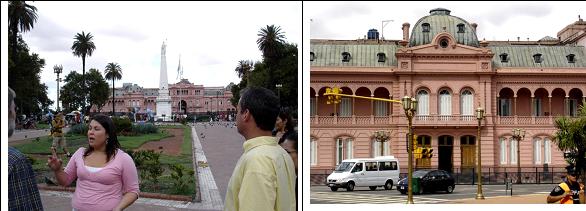
Earlier in the …
Argentina – Part 3
March 2006: La Plata
By JJ Jonker
It was easy to navigate La Plata on foot using a map from the hotel, as the town is laid out in a square grid of streets and avenues – all numbered – with a few diagonals that run from corner to corner. Wherever the diagonals cross (every 6 streets/aves) there is a roundabout or park with vandalised sculptures and monuments.

All streets are one-ways, except for the tree-lined main arteries (every 6) with NO traffic signs. Everybody yields (or is supposed to) to the right. So you only slow down through the intersection, check and go. This slows down all traffic to around 40km/h. Unless your mode of transport happens to be the double cab bakkie of the Police Airwing, in which case you don’t slow down. Everyone else must maar look out on your behalf.
At the top of the town (6 streets up from our hotel), there is a park with a zoo, and we walked up there around 10 am. The surrounding streets are popular for jogging, and a number of people partaking in a road race passed us. The park is well laid out, and appears to be from a more opulent era, with maintenance now sorely lacking. There is an impressive sports complex, including a stadium with a well-maintained pitch. But the buildings are dilapidated, ticket windows shuttered, gates chained up, dry 6-lane looks-like half-olympic size swimming pool, filled in public pool in the park, dirty dam, abandoned/non-operative rental paddle boats, missing plaques and statues, general vandalism, graffiti and even an observatory, which has been closed down.

The zoo itself has quite a variety of animals, mostly one of each, but we saw lions, tiger, black bear, empty jaguar cage, giraffe, Indian elephant, two monstrous white rhinos (never seen such huge ones before, not even at home), their equivalent of springbok, eland and silver jackals, emus, a wallaby, llama, flamingos, macaws, buzzards, marmoset monkeys and a werfbobbejaan [baboon]. Rubber trees squeeze palm trees to stay upright – reminding one of the trees growing through Inca temple ruins.
The zoo buildings also are pretty much in need of maintenance. Paving is broken due to tree roots, windows smashed and boarded up, the toilet facilities have no lights, seats or paper, with general upkeep lacking everywhere.
At lunchtime, a restaurant opens on the pavement outside the zoo. It is literally a take-away restaurant – they take the restaurant away at the end of the day, until next Sunday.
We unfortunately did not know that this was going to happen, as the pavement was empty when we entered the zoo, and had by that time already consumed a terrible mini-pizza at a kiosk inside the zoo. But the smell was divine, exactly like boerewors. Also just about any cut of meat you can think of, hanging in pieces the size you normally see in a butchery, which is then cut up as per order prior to cooking. Lots of families have lunch here, making a happy noise.
Police presence is very evident – wearing day-glow orange bibs – patrolling the streets against car-theft. We witnessed a local being arrested right opposite the side-walk restaurant. The perpetrator did not want to come quietly, and the policeman was sitting on top of him, unable to let go to get the hand-cuffs on. It took 3 more officers (one a lady) to get him handcuffed and on his feet, and still he tried to head-butt them. The original arresting officer, once he dusted himself and got his breath back, was physically chased away by the lady officer. She probably correctly understood that he was now going to bliksem [stuff up] the skelm [offender] that gave him so much trouble. He probably did later, when there weren’t so many witnesses around.
The highest point in town is marked by a traffic island in the middle of the park area with a – as per usual – vandalised, graffiti’d monument. I commented that the moment I see this behaviour at home, I’m leaving.
Vandalism
The vandalism came about due to the collapse of the Argentine economy in 2001, when people fearing the worst began withdrawing large sums of money from their bank accounts, turning pesos into dollars and sending it abroad, causing a run on the banks. The government then enacted a set of measures effectively freezing all bank accounts for twelve months, allowing for only minor sums of cash to be withdrawn.
Because of this allowance limit and the serious problems it caused in certain cases, many Argentines became enraged and took to the streets of important cities, engaging in a form of popular protest – banging pots and pans. These protests occurred especially in 2001 and 2002. At first the cacerolazos were simply noisy demonstrations, but soon they included property destruction, often directed at banks, foreign privatized companies, and especially big American and European companies. Many businesses installed metal barriers because windows and glass facades were being broken and even fires being ignited at their doors.
The president declared a state of emergency, but this only worsened the situation, culminating in the violent protest of 20 and 21 December 2001 in Plaza de Mayo, where demonstrators clashed with the police, ending with several dead, precipitating the fall of the government.
In 2002 the peso, which was linked to the US dollar in a 1:1 ratio at the time, was fixed at a 1.4 peso/dollar rate by the banks. In the open market however, within a matter of days the exchange rate worsened to 4 pesos/dollar.
So practically overnight, the middle class became poor, further fuelling the anger, leading to the trashing of buildings and other public property. In La Plata, there certainly is not much more that could be damaged, so thorough have they been. Some marble statues have only the feet remaining on the base. Bronze sculptures have fingers smashed off, and even Evita’s granite plinth on which her bronze bust is mounted, has been broken.


The economy has since improved significantly, with the Argentinean Peso trading at ARS2.8/USD during our visit (2006), but not yet to the point where there is money available for the rehabilitation of this damage.
This lag of replacing luxuries is also …
The theory of evolution
The origin of buildings
[It’s just a theory, really….]
By JJ Jonker
Many years ago, just about right after the coming into existence of man – as in Homo Sapiens – the requirements for survival were very basic. This was well summed up by Maslow (a while later) as depicted graphically below:

Back then, man was mucking about pretty much at the bottom of this hierarchy, slowly progressing to Level 2, where as part of Safety and Security, shelter became an important issue. Primarily from the elements, but also from wild animals and later – following Cain’s poor example – against the attack of other groups wanting his possessions. The last parameter had not changed much over time and we still have the same problem today.
Now, as the anthropologists have discovered, man at the time was a hunter/gatherer. The men hunted, the women gathered. He lived in a cave which gave good shelter against the elements, but was pretty much a sitting duck once trapped there by the Tsotsis of that time.
This was a major drawback, as he only became aware of any threat once it was upon him, and this was the main reason why a lifestyle change took place – moving into a more open environment. The challenge was now to design and put up a free-standing structure of some sort to provide the required shelter – this in itself being quite an evolution. Lateral thinking, we would call it today.
Once he had cleared the area – so he could see sufficiently into the distance – man reasoned that seeing as he now has this piece of bare level ground, he may as well plant something there. This would reduce his risk in getting killed during a hunting expedition and also extend significantly the time he could sit in the shade of a tree and drink beer.
He started cultivating the soil ploughing with some antelope which he captured and domesticated. Soon he was farming comfortably. Thus it came to be that all the activities on the lowest level of Maslow’s triangle had been accomplished, and it was now time to progress to the next level – shelter.
So he planted some posts interconnected with an inner and outer lattice of green boughs, filling the cavity with rocks. This worked really well in summer, due to the excellent ventilation and flow-through of air promoted by the gaps between these rocks.
During winter however, it was a very different story. The wind came right through these same gaps, and man realized that he needed to update his design in order to eliminate this problem. What to do, what to do …..
Then it hit him. Cowpats. Just pick them up from behind the plough and plaster the gaps between the rocks shut. And it worked real fine. Bear in mind that this came way before the invention of the wheel, so rates as a major discovery.
Seeing as man had used mostly bull dung for this plastering purpose and that the word “house” did not exist yet, he would at the end of a hard day’s ploughing announce: I’m going bulldung now”. Which meant that he was going home to have a beer.
Of course all this happened before man could even write, so this story was told around the fire, generation after generation, and by the time that it was actually recorded in writing, the term “bulldung” had become somewhat corrupted.
This was mainly due to ancient man’s migration downwards through Africa, and the way the colloquial pronunciation varied the further south he went. This is a natural phenomenon and still the case today, e.g. in Gauteng (north) the second vowel is pronounced ê, and in the Western Cape (south) as è. In the same way, “uh” changed to “ih”, and bulldung became bullding).
Through the next couple of millennia – as with everything else – the written language of course evolved considerably, until we arrived at the word we all know today as Building.
So, there you have it.
JJJ…