Author Archive
Carbon Tax
By Johnie Jonker
A report from the Nordic website of ICE News stated the following:
Denmark wants to tax cow farts

The latest climate-friendly tax being proposed in the Danish parliament focuses on the methane emissions that come from cattle when they break wind. The agricultural methane tax is certainly one of the more controversial measures currently being considered by the government.
The Tax Commission, which is behind the measure, estimates that each cow releases around four tonnes of methane each year simply by passing gas. In comparison, the average car emits just 2.7 tonnes of unwelcome emissions per year. Naturally, the Agriculture Council and many other groups have been lobbying hard against the new proposal. For the full report visit:
http://www.icenews.is/index.php/2009/03/03/denmark-wants-to-tax-cow-farts/
This goes a long way to explaining why the implementation of carbon tax on motor vehicles worldwide – and recently also here – has been based on a complete misunderstanding, and should be abolished immediately.
The trouble started due to the different ways in which various regions pronounce the same word, e.g. the fact that although still classified as English, the Queen’s version differs considerably from that of the American and Australian versions, to name but two.
The actual event was a speech made by Bruce Wallaby from PATROL (People Against Taxation, Randomly or Otherwise of Litres) – litres of course referring to the displacement of car engines – in the Australian Outback. For those who are not familiar with this organization, they were previously known as FLOB (Four Litres Or Bust), but once again due to their colloquial pronunciation of this acronym in English, this sounded too much like an unsuccessful venture, hence the renaming.
There is also the theory that the new name was chosen because of the organization’s modus operandi. Small communities in the Outback were targeted initially with their cause. Due to the absence of soapboxes at these venues (all burnt up for fire-wood) Bruce had nothing to stand on to elevate him somewhat above his audience during these speeches, so he stood on the roof-rack of his 1960s vintage large Nissan SUV.
One of these events was attended by a journalist commissioned by the EU – which has its headquarters in Brussels – on a fact-finding mission regarding pollution causes. This is how it came about that while Bruce was emphasizing exactly what the newspaper report above stated – that pollution caused by COWS is a much bigger problem than that of motor vehicles – Roel Aerts (the Belgian journalist) was jotting down what he heard.
Now, prior to coming out to Australia, Roel had studied some of the pronunciation differences pointed out above, and also some key words. For instance, being from the Flemish part of Belgium, a motor vehicle was known to him as a “wagen”, but he knew that Down Under they would use the word “car” instead.
What he also picked up – sharp guy! – was that the Australians tend to not pronounce the “r” at the end of some words, and also stretch short vowels, so when Bruce mentioned the word “Cows”, Roel heard “Caaes” and translated this to mean “Cars”.
Back home, Roel reported his findings to the EU, resulting in – straight away – carbon tax being slapped on motor vehicles throughout Europe, from where it spread worldwide.
So in fact – and actually what Bruce had said – it’s the COWS and not the CARS that is responsible for the major portion of the world’s pollution.
JJJ…
On Wings of a Trike
During every holiday, in addition to caravans, a good number of cars tow trailers with motorcycles, quad bikes and boats, to be used at the holiday destination. Not seen recently though, is someone towing a micro-light aircraft.
The one time I do remember noticing one, was when it was behind my car on the way to De Put, my friend Charl’s farm in the Karoo. De Put is located distance-wise just about dead-centre between Aberdeen, Murraysburg and Nelspoort. This was the first time I had towed over such a distance, but as the trike is designed to fold up compactly, and due to it weighing less than 150kg, quite an easy tow.
First we had to attend to a make-shift landing strip on a salt-pan (32°18’58.2”S, 23°32’53.72”E).

The trike in the background belonged to a neighbouring farmer. It shared the hangar with an owl, which regularly plastered the wing.
Oh, the pumpkin? Well, yes. The wind started blowing very strongly in the afternoon, and the upwind wingtip needed to be tied down to prevent the trike from being flipped upside down. The neighbour’s wing we could peg down with a piece of fencing post that was on the back of the bakkie, but all that was left for ZS-WGR, was the pumpkin. It worked just fine.
Some of the farm labourers had flattened the bushes, although calling the bushes dead sticks, would be more accurate. Taxiing out the farm gate from the garden, was quite a novel experience. I mean, picture this: “Please open the gate, son. I’m going for my daily water-point inspection”.

Take-off on the road at the homestead was possible, but landing at the same location not, in spite of Charl having graded the road with a blade attached to his tractor to rid it of loose stones. The Class-C road was just too narrow, with a converging telephone line, middelmannetjie and flood-humps to boot; the least amount of cross-wind pushed the trike off track when power was taken off during the flare. This possibility fortunately occurred to us prior to the maiden take-off, and the alternative landing spot was prepared the previous day.
Now might be a good time to mention that I have a bit of a reputation.

Nothing serious, really. In any event, in spite of my reputation I had passengers for every flight. As reward, the guys that prepared the runway were offered a flip, but only one accepted. So up we went, with an intercom connection in the helmets to enable pilot and passenger to communicate with each other. Via the intercom I pointed out the familiar features that my passenger knew from ground level. However, my headset remained deathly silent. My enquiry whether he could hear me eventually elicited a very high-pitched “yes?”, squeaked by my witlessly scared passenger. I realised that the tallest perspective he had ever experienced to date was standing on top of a windpomp platform, hanging on for dear life, looking for missing sheep.
Realising the state of my passenger I returned to base. Upon being asked by Charl how it was, my passenger very politely, though unconvincingly, responded that it was “good”. When pushed for an answer which spot he liked most, the response was a rather more accurate: “Right here where I’m standing now, sir”.…
Karoo pictures
Pictures by Johnie Jonker
Karoo

Sometimes there is water – even in the Karoo.

Some folks have left, though


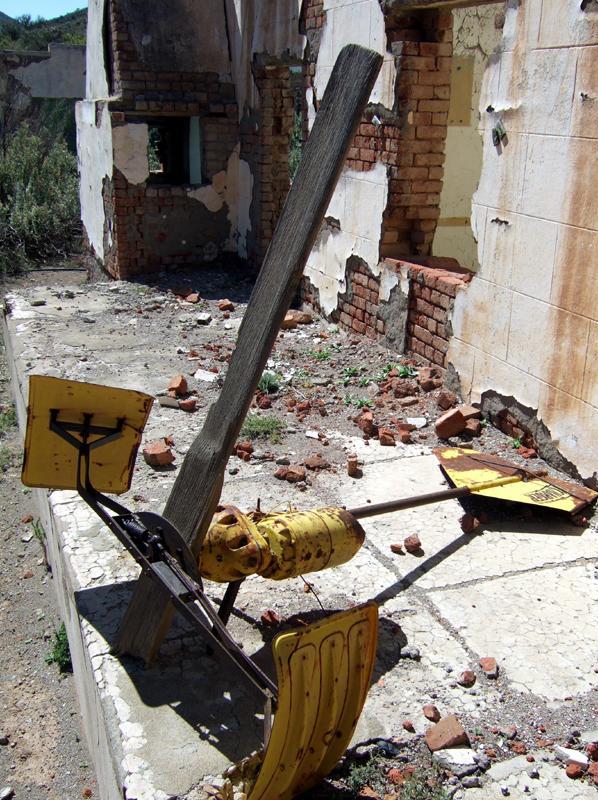
A bekslaner gate (a ‘chin hitter’ would be a fairly accurate translation)

Trusted companion. Mode of transport. Grandstand seat. Leisure traveller too.

Local wise man says: no tube. Put in as many plugs as necessary.
Local wise man also says: don’t bother making the plugs neat on the outside. Karoo bossies will do it for you.
 …
…
Namibia – Part 1
[Namibia tour 2000]
By PG JONKER
[Adapted version hereof published in Leisure Wheels, November 2010.]

[Source: Map data ©2014 AfriGIS (Pty) Ltd, Google]
Cape to Okahandja
Border crossing
It can be considered a strategic error to embark on a Namibia tour on the day after the Western Cape Schools have closed for the winter holidays. This was our folly. The whole of the Western Cape (and half of the other provinces, it seems) are there. It’s like a church bazaar on the platteland, (rural area) only there are even more cars.
Our convoy of three vehicles arrives at Vioolsdrift with a queue of cars of way in excess of a kilometre long. As law abiding citizens should, we join the back of the queue. We get out our samies and start nibbling away, expecting some forward movement in the line of cars. After a while we realise that this is not how it works. No, you’re supposed to walk to the front of the queue with your papers, and join another queue of pedestrians at the administration office. And we soon notice that the guys in the queue are not as amicable as guys queuing for pancakes at the church bazaar.

In spite of it being mid-winter, the sun starts tugging at exposed skin where we stand in the queue for more than an hour. Frikkie laments the fact that he had his bakkie serviced before our tour. If he knew he would have so much time he would have come and serviced his car whilst waiting for the immigration officials. Frikkie does things like that.
Once at Noordoewer on the Namibian side we are now a lot wiser. Even before we came to a proper stand still half of our touring party is out of the cars and heads for the immigration offices. Only to be shooed back by the Namibian official in charge of the logistics. Here you wait at our car until it is your turn.
The Noordoewer side does not boast a PC to speed things up. Everything is done by hand. This whole South African cavalcade is dealt with by two immigration officials. Two officials also deal with the (non-existing) stream of vehicles leaving Namibia for South Africa. They have nothing to do, but clearly do not see the value of assisting their hapless colleagues on the other side. It therefore takes a cool two hours before we are done with the paper work and able to hit the road again.
Ai-Ais
We set our watches an hour back and set out for Ai-Ais with what seems like another hour’s daylight left. We arrive at Ai-Ais after dark. The camp site is chock and block full. It seems like all those who were fortunate enough to be at the border before us also headed for Ai-Ais and got all the good spots.
Following floods in the previous moths we find the facilities no yet fully repaired. There are also fewer camp sites available. Those with roof top tents simply make camp in the road. The best we can do is to gate crash on the personal space of some other campers.
The next day it becomes clear that most people used Ai-Ais simply as a stopover, as the park is considerably less populated by noon the next day. We stay for two nights. In spite of the facilities being in a state of repair we enjoy our stay.

On our second night we find Colin starting to experiment with alternative ways to pack his plastic table into the back of his Nissan double cab. For the rest of the tour this became a routine pasttime of Colin each evening. I can report, however, that by the end of the tour Colin was still unable to find a more effective way of packing his plastic table, but definitely not due to lack of trying!
We leave Ai-Ais en route the view point at the Fish River Canyon to take the “been there dunnit” pictures before we head for Hardap.

For the sake of the children we limited our travel distances per day. However, upon reflection it would have been better to have travelled to Windhoek in one day, rather than to interrupt the day’s travel to stay over Hardap dam. That is, especially since we used Hardap only for a stopover.
At Keetmanshoop we stop at a shop to replenish some stock and to eat hour picnic lunch. Two locals suddenly walk right into our circle and starts checking out what’s for lunch. Two car watches arrive virtually simultaneously and chase them away.
Hardap dam
At Hardap we are unfortunate enough to arrive after all the camping sites with some lawn have been taken. We end up in a dusty part of the camp where we apply our West Coast style roll-on lawn in the form of anchovy net and set up camp.

The next morning it takes a while to get all the duwweltjie thorns out of our stuff so that we can pack. We stop at the Kalahari Bar, the apparent entertainment centre of the Kalkrand Hotel. With difficulties we fend off the unsolicited windscreen washers.

Just outside Windhoek we are stopped at a road block. Passports are checked, and we are waved through. We take the Western bypass from where we turn off on the C28, Westward, to Daan Viljoen.

[Source: Map data ©2014 AfriGIS (Pty) Ltd, Google]
The facilities at Daan Viljoen are in tip top shape. The temperature, though, goes to extremities, causing us to have a rather bad night. To add to that, it turns out that Hardap’s duwweltjies (nasty three-pointed little thorns) have done their thing to our double air mattress. After a few sessions at pumping up the mattress we give it up, pull out the plug completely to stabilise the mattress and try to make ourselves comfortable. At dawn we find ice on the tents, with everything that was left outside frozen solid.
Just outside Windhoek we are waved through at the last road block for the tour. At least by then we are relatively defrosted.
Just as we enter Okahandja there is a large crafts market where we spend some time. I am notoriously bad in resisting aggressive sales people and rather keep my …
Namibia – Part 2
[Adapted version hereof published in Leisure Wheels, November 2010.]

[Source: Map data ©2014 AfriGIS (Pty) Ltd, Google]
By PG Jonker
Waterberg to Etosha
Waterberg
The facilities at the Waterberg outside Okakarara are very good, with warm water and electricity. We find it a bit difficult to figure out which braai area belongs to which campsite. Judging from the somewhat perturbed “and where must we now braai?” from our neighbours upon returning from a drive, I believe we, in fact, inadvertently took over their braai area in their absence. 
The Herero lady who helps us at the reception desk quickly changes over to Afrikaans after flinching in response to my English endeavours. She is just as comfortable, though, assisting the overseas visitor waiting next to me in English. The German speaking gentleman on my other side also enjoys the courtesy of being served in German.
At a later stage during our stay our paths crosses hers, and she volunteers to take us on a guided tour through the history of the old buildings. She is a true ambassador not only for the Parks authorities, but also for Namibia.
In August 1904 the Battle of Waterberg took place between the Germans and the Hereros. The Hereros escaped, but their retreat into the desert led to their near extinction at that time.
The old building at the Park that now hosts a restaurant used to be the police station in 1904.
Etosha
Our next port of call is Etosha.

Within 5 minutes of us entering the Etosha we stop at a water hole where we see a great many species of animals. Gemsbok, Springbok, Vlakvark, Giraffe, Zebra, Blouwildebees, Kudu, Black nose-impala’s, jackal. A herd of elephants lingers on the side. Later they approach the water hole and chase all the animals out and take over the water hole. Then a large bull comes strolling along and chases all the animals away. Now he has the water hole for himself.

After reporting at Okaukujo we drive out to Halali where we will set up camp. Lonely Planet’s book describes the campsite as a dust heap. Quite right, they are. [I should remind the reader that this tour was many years ago – things might have changed since].
That night at the water hole we sit in awe and watch as three rhino’s come for a drink. Ever so often one would hear a soft appreciative “aaahh” from someone. It is a serene and sacred atmosphere. Until the silence is ripped apart by a five year old boy who, like Shreck, appears to have been born under the star sign of the flatulent. It was not as loud so as to disturb the rhino’s, but pretty much everyone else heard it. Nobody says anything, but after the initial shock, it appears as though everyone is sitting in a bus driving on a corrugated road. Bodies shake, but everyone tries not to laugh out loud, until, eventually, everyone laughs, except for a little boy and his mother. Sacred moments, I’m telling you.
Lion hunt
On a game drive with the family, I inadvertently drive right into a lion hunt. We spot a large male lion just left of the road behind us. I reverse with the Venture to get a better view. The next thing the lion gets up, and starts to run right at the Venture. I watched in shock, for the moment not sure what’s happening. But the lion runs past us, and only then do we notice a small herd of black nose impalas [well, that’s what it looked like judging from the manual] coming from the opposite direction, unaware of the lion. At a distance we can make out a number of female lions on the far side of the antelopes.
The male lion aims for the nearest of the antelopes, but we have thwarted his endeavours. It is clear that the antelopes also realise that the lion is not going to make it to them in time, because they trot away with no visible indication of alarm.
When everything quiets down I remember my camera is still in the bag. I grab the camera and take a picture of the lion; however, all that remains visible of him is his rear end.

Frikkie and his coil
I had myself talked into driving up to Epupa falls by a colleague of mine. Collin decides to join us, but Frikkie and his family decide to rather stay in Etosha for a few days longer. We will meet up with them again at Long Beach.
Our ways part when the two families heading for Epupa swings west from Halali, while Frikkie and his family heads east for a game drive. Then, 4kms later, Frikkie’s Hilux comes to a dead stop. Now this is the kind of thing that will truly spoil my holiday. Frikkie, on the other hand, thrives on challenges such as this one.
A friendly holiday maker tows Frikkie back to Halali. A qualified mechanic joins Frikkie in his search for the gremlin. They decide the offending part is the coil. Just to make sure they need a similar coil to test on Frikkie’s bakkie. No problem, just find another Toyota Hilux. Frikkie finds a similar bakkie in the camp and trace the owner thereof as one of the waiters working in the restaurant. Taking the coil on a loan and testing it on Frikkie’s bakkie confirms the coil to be the problem. Frikkie offers to buy the waiter’s coil, but for obvious reasons this gentleman is disinclined to this transaction. Eventually they agree that Frikkie will rent his coil for R100 to enable him to drive to the nearest town in search of a replacement coil. With one of his kids being ill, Frikkie leaves the family at Halali and sets off for Tsumeb. Not even a herd of some 20 elephants amuses Frikkie, he’s got more important things to be concerned about.
At Tsumeb he finds a yard with a number of stock cars. After some negotiations he buys a coil off one of the stock cars, and heads back for Halali. Relieved to be back at Halali after a day on the road, Frikkie finds his family eagerly awaiting his return, ready to go for a drive.
Part …
Namibia – Part 3
[Adapted version hereof published in Leisure Wheels, November 2010.]

By PG Jonker
Etosha to Epupa Falls to
Swakopmund
Epupa
After attending at Kamanjab’s bakery, Colin and we head for the guest farm Rustig where we will camp.

However, a few kilometres short of Rustig I get my second flat tyre for the day, on the same tyre. The tyre was repaired at Halali and put back. This time I need to use my own jack to change tyres, only to find that my jack is not working properly. By the time I’m done I have a bent jack. My spare tyre, I notice, had been plugged before, and it is not the same size as the rest of the tyres.
The sun is setting in the West and it will appear that the trip to Epupa might not happen. It is 18h00 on a Saturday evening.
It turns out that Jörgen Gotshe’s farm bakkie on Rustig is a Toyota Stallion that runs on the same size wheels and tyres as my Venture. He suggests that I leave my flat tyre with him for repairs, and take two of his wheels on board. We’re back in business!
I repack my Venture to fit in the extra spare wheel. Do you have any idea how much space such a wheel takes up in your boot?
That night I cannot sleep. I’m stressed out about my tyres and my jack that is not working properly. Jörgen makes regular trips to Epupa with his Kombi, he told us. It is not strange to get two flat tyres on that road, and on occasion he had three flat tyres on one trip. It does not bother Jörgen, because like Frikkie, he just takes along all the appliances needed to do the repairs. Do not have those appliances, and even if I take it along, I will not quite know what to do with it. We are also alerted to be on the lookout for puff adders and crocodiles. Mmmm …..
We leave Rustig early the next morning in piercing cold and windy conditions. The gravel road heading north to Ruacana is very good. It runs right next to the extreme Western border of the Etosha Park.
We reach what appears to be a veterinary gate. We now travel from Damaraland into Kaokoland. We take the turn off to Opuwa, where we will up before heading for Epupa. From there it is a further 112km to Okongwati. The road is still good, but a great number of drifts [causeways] require you to slow town to first and second gear to traverse it in safety.
From Okongwati to Epupa we drive the last 75km’s. The road is not much worse than a bad farm road. However, if you expect to be done with this stretch of road within an hour and it takes more than three hours it becomes very frustrating.
Shortly after Okongwati we reach a sandy riverbed. I have my doubts whether I should proceed, fearing that I might get bogged down in the sand. However, Colin is already halfway and I follow suit.
Some parts of the road show no similarities to what is known as a road in the classical sense of the word. You choose between the rocky part left and the rocky part right. We bounce onward.
 Good humour has left the Venture. My wife does a brilliant job keeping the kids happy, but she also does not quite enjoy having to contend with the stuff that had to make place for the extra spare wheel, most of which landed on her lap.
Lonely Planet’s book says the Epupa falls “defies description”. However, I was very near to reaching the point where I felt “f** the falls!”
And then, at last, we look down on the main fall in a series of falls. And indeed, it defies description. The falls stretch over 1,5km of cascades, with the first thereof a 37m fall.
Breathtaking!
 We get a camp site right on the edge of the water, some 60m upstream of the main fall. The noise sounds like white noise. Rather loud white noise. The kids swim in some of the naturally sculpted Jacuzzis where the water is shallow and clear – so that one can see there are no crocodiles.
Just outside the gate of the fenced camp site a few Himba ladies are seated under a tree. They wait to be approached for pictures. I’m not comfortable talking money business with scantily dressed ladies and I ask my wife to do the negotiations on my behalf. For R5 I may take pictures of the lady and her baby.

Next to us is a group of overlanders who took the challenging route from Ruacana to Epupa. Their Gelandewagen had to tow the Toyota RAV uphill at times because the RAV lacks low range. They are very impressed finding my 2×4 Venture there. However, when they eventually leave with the (sissy route) road to Okongwati they will realise it was no big deal to get there, really.
The return trip is much more relaxed now that we know what to expect. We fill up again at Opuwa. At Rustig I hand back Jörgen’s two spare wheels and take my (now repaired) wheel on board again. We head for Khorixas.

[Source: Map data ©2014 AfriGIS (Pty) Ltd, Google]
After 11 hours on the road, having travelled 580km for the day, we reach Khorixas. The facilities are good and we order take-aways from the restaurant in the camp.
West Coast
The road from Khorixas to Henties Bay passes a distance away from the Brandberg. Eager to reach the coast we do not turn off at Brandberg.

Approaching the sea we realise we are sea people. Not anglers, fishermen or swimmers. We just like the smell, the sight and the ambience of the sea. It is a wonderful sight with the Atlantic Ocean expanding to the West.
After having split up with Colin at Khorixas we drive on our own. At Langstrand Caravan Park between Swakopmund and Walvis Bay we meet up with Colin & Frikkie again.
In the Swakopmund museum I get a very nice picture of Die Wit Vrou without having had any trouble to have gone in search for her at the …
Namibia – Part 4
[Adapted version hereof published in Leisure Wheels, November 2010.]

[Source: Map data ©2014 AfriGIS (Pty) Ltd, Google]
By PG Jonker
The long drive home
After a quick stop at Solitaire (no, we did not stay long enough to enjoy the renowned apple strudel) we headed for Sesriem. At the turn off to Sesriem we meet a foreign tourist on a bicycle. He is on a solitary tour through Southern Africa with his bicycle.

We fill up at Sesriem and learn that Sossuvlei has water. This, I’m told, happens about once a decade and is a must see. The effect of the dune riding on the backs of both my wife and I compels us to give this a miss. We have difficulties just finding a body position that is relatively comfortable. We therefore head for Maltehoë, while Colin and Frikkie and their families head for Sossusvlei. Having seen their pictures afterwards, of course, made us wish we rather hung on and went to have a look for ourselves.
We stay over at Die Pappot at Maltehoë where Mannetjies and his wife go out of their way to make things comfortable for us.
Mannetjies has a room which we would like to use, but he apologises for the fact that the room is (for the moment) not fit for human occupation. It turns out that a foreign tourist on a bicycle stayed there for a few days, and his culinary endeavours left a smell that it rather difficult to stomach.
I mention to Mannetjies the foreigner on the bicycle that I met near Sesriem, to which Mannetjies has some rather unfriendly suggestions as to the treatment of said foreign tourist in such a remote location.
By late evening Frikkie joins us, but Colin headed for Duwiseb and will be touring home on his own.
We depart early the next morning. About 90km’s before the SA border we stop to assist a family whose left hand drive Ford Explorer refused to start again after losing a tyre. The Explorer has a safety mechanism that deactivates the fuel pump if it detects a bang of some sorts. A notice in the engine bay says the fuel pump just needs to be reset, for which purpose the manual should be consulted. Something that Siegfried does not have.

Frikkie does not take kindly to encountering a mechanical problem that he cannot solve. Eventually he tows the Explorer to Vioolsdrif after the drive shaft of the automatic Explorer has been removed. At Vioolsdrif we have cell phone reception. A call to the dealer quickly leads to Siegfried finding the reset button under the carpet of the passenger seat, and the Explorer is up and running again.
We leave Vioolsdrif after 17h00. We bade Frikkie and his family goodbye at Vanrhynsdorp. At 00h15 that morning we bade Siegfried and his family farewell at the turn-off to Durbanville. By 00h45 we are home. By 01h00 everyone is asleep.
Home sweet home.
TOUR STATISTICS:
Distance travelled: 6060 km
Litres used: 611
Fuel consumption: 9,9 km / litre (Toyota Venture)
Nights out: 14
Tents pitched: 9 times
Car trouble: PG: 2 flat tyres; Colin: 1 flat tyre;
Frikkie: one bust coil
Lessons learnt
Etosha
Once you have entered the Etosha National Park you are bound to see Springbok and Zebra. There is no need to be in a hurry to take a picture. Trust me, there will be more.
Distances
One can easily misjudge travelling distances in Namibia. It is a vast country, with roads mostly gravel. It is easy to attempt to do too much in one day, forgetting the type of distances you have to contend with.
The other thing is, you may start planning a trip to Ai-Ais. Then you look on the map and you see, well, you are so near to Duwiseb, you can just as well go visit Duwiseb castle. But once you reach Duwiseb, you are, in Namibian terms, relatively near Sesriem and Sossusvlei. Once there, Solitaire is just around the corner. And surely, once you have reached Solitaire, you need to go see Swakopumd, it’s so close. Now once you have reached Swakop you should go and have a look at Henties, especially if you do a bit of angling. And from Henties it is not that far to the Brandberg. You get the idea. And before you know it, your visit to Ai-Ais ends in Etosha – while you are mos in the vicinity.
It is in this fashion that, having reached Etosha, some of us decided to head for Epupa falls.
The Ova-Himbas
Along the road we see traditional kraals that seem to have been opened up for tourists. The downside, in my view, is that every Himba that walks along the road now seem to expect to be photographed and paid for. It’s a pity, because they strike you as a proud and dignified people.
Dune riding
Chasing down dunes with a sand board is great fun. I’m not sure whether there are any instructions to be followed as to how you should do it, but we did so sitting on the boards. This seems to have been a mistake. By the next day both my wife and I had such lower back pain that we did not even had the heart to drive in to Sossuvlei, that offered the rare sight of having water!
Tyre Maintenance
For reasons I cannot remember any more I had a tube inserted in my tubeless tyre. This caused me two flat tyres on the same day. It turns out that the tyre had previous repairs done to it, with plugs inserted. These plugs caused friction between the tube and the tyre, causing the tube to burst.
Next time I will have as many plugs inserted in my tyre as it may take, but I will not have a tube be put in again, save for whatever emergency that may make any other option impossible.
PGJ…
Die ‘Hall’
Weskusstorie
Deur Johnie Jonker
Jare gelede het daar op St Helenabaai ‘n man gewoon met die van Jonker, maar mens sou verskoon kon word as jy gedink het sy van was Meneerjonker, want dis hoe die meeste mense hom aangespreek het.
Meneerjonker was die bestuurder van een van die visfabrieke, Suid-Oranje Visserye Bpk, geleë te Sandy Punt. As jy van Vredenburg af gekom het, het jy eers by West Point, Brandhuis, Steenberg’s Cove (met die hotel, polisiestasie, slaghuis, winkel en poskantoor) verbygery. Dan om die draai by die Pienaars se plaas op linkerkant, en net daarna SOV aan die regterkant. Hierdie fabriek was die breinkind van wyle AP du Preez, en die ontstaan daarvan is genoodsaak deur vooruitgang, en wel van die volgende aard.
AP du Preez se eerste fabriek, Midwest Canning Co, was langs die Pedro’s se Padkafee (deesdae ‘n backpacker’s lodge) binne die rifbeskutte Vioolbaai geleë. Eendag met spring gety kom een van die bote terug van die see af kaai toe via die gaping in die rif met ‘n buitengewone swaar vrag vis (jy kon dit nog nie ‘n vistreiler noem nie, want dit was te klein, maar dit sou in die plaaslike spreektaal onder die kategorie van “skeide” val).
Toe steek die boot se kiel vas op die sandbodem, en moes wag vir hoogwater om te kon afdryf. Intussen blokkeer dit die ingang deur die rif, en die ander vol skeide kan ook nie vis aflaai nie.
Geen problem: die opening in die rif word dieper geskiet, en vir ‘n ruk lank is die ou sakie opgelos, maar AP du Preez weet dat dit net ‘n kwessie van tyd is voordat nuwe bote heelwat groter as die huidiges gaan wees, en dan glad nie deur die passasie kan vaar nie. Toe bou hy solank ‘n nuwe fabriek, SOV.
Nadat die nuwe fabriek ingebruik geneem is, is daar nog vir ‘n ruk lank kreef verpak by Midwest, want dit is gevang deur skeide (40 voet Tjak-Tjakkies) wat wel deur die rif kon kom, maar dis ook later gestaak. Toe ontstaan die vraag: Wat nou gemaak met die ou fabriek, want dit staan nou leeg en loop gevolglik sleg deur onder vandalisme.
[Dit was great fun om die klein venstertjies van die gebou met klippe uit te gooi – so is my vertel – PGJ]
Waar die nuwe fabriek wel tekort geskiet het, was in stoorspasie om die sakke vismeel te stoor, 20 op ‘n pallet, 4 pallette hoog. Want as al die fabrieke volstoom gewerk het, kon SAS & H nie voorbly met die wegry daarvan met hulle RIO trokke na Vredenburg se stasie nie (die bestaan ook nie meer nie, verstaan ek), vanwaar dit verder versprei is.
Daar word toe besluit om Midwest vir ‘n transito stoor te gebruik, en oom Gert Smit (sien https://pgjonker.co.za/?p=551) ry heeldag, week na week vismeel aan met die MAN trok na die ou fabriek, wat net so 2 km weg was, tot die Spoorweë die agterstand ingehaal het.
November breek aan, met jaar-eind-funksies wat deur elke gemeenskap gehou word en wat gewoonlik uit ‘n dans met ‘n plaaslike orkes bestaan. Die probleem is net, daar is nie ‘n danssaal op St Helenabaai nie.
Omdat die visseisoen destyds geloop vanaf 1 Januarie tot 31 Augustus, was al die vismeel teen Oktober egter reeds weggery “dorp” (Vredenburg) toe, en die organiseerders kom toe op die idee om te hoor of hulle nie een van Midwest se leë vismeelstore kon gebruik vir hulle funksie nie.
Daar was voordele in vir beide partye: Die dans-organiseerders kry die saal verniet, en die fabriek kry ‘n baie mooi skoongemaakte stoorplek terug vir die nuwe seisoen. Dus ‘n simbiotiese verhouding. Die een of twee aande in die jaar wat Meneerjonker en sy gesin tot die vroeë oggend-ure moes wakker lê en die musiek verduur (dit was nie sy soort nie) wat van die see af die bult opgerol het huis toe, was darem nie te duur ‘n prys om te betaal nie.
Hierdie huur van die stoor het toe ‘n jaarlikse instelling geword. In die tyd was daar toe ook ‘n stadium wat die plaaslike gemeenskap deur ‘n fase gegaan het waar dit meer fatsoenlik was om Engels te praat. Die venue het sodoende mettertyd bekend gestaan as “Mister Jonker’s Hall”.
Maar net soos die Engelspraat nuk opgevlam het, het dit weer bedaar, en die mense het weer Kaaps gepraat.
Daarmee saam het die venue toe weer bekend geword as “Menee Djonke se Hôl”.
JJJ…
Desiderata
Following my previous posting “Trust me on the sunscreen” [https://pgjonker.co.za/?p=650] a few people made the connection between that speech and the poem Desiderate, written by Max Ehrmann in 1927.
Now to be honest, I’ve never heard of Max Ehrman or Desiderata before. So I went looking for it, and yes, the tone seems rather similar. Below the poem as I got it from http://en.wikipedia.org/wiki/Desiderata:
Desiderata
Go placidly amid the noise and haste,
and remember what peace there may be in silence.
As far as possible without surrender
be on good terms with all persons.
Speak your truth quietly and clearly;
and listen to others,
even the dull and the ignorant;
they too have their story.
Avoid loud and aggressive persons,
they are vexatious to the spirit.
If you compare yourself with others,
you may become vain and bitter;
for always there will be greater and lesser persons than yourself.
Enjoy your achievements as well as your plans.
Keep interested in your own career, however humble;
it is a real possession in the changing fortunes of time.
Exercise caution in your business affairs;
for the world is full of trickery.
But let this not blind you to what virtue there is;
many persons strive for high ideals;
and everywhere life is full of heroism.
Be yourself.
Especially, do not feign affection.
Neither be cynical about love;
for in the face of all aridity and disenchantment
it is as perennial as the grass.
Take kindly the counsel of the years,
gracefully surrendering the things of youth.
Nurture strength of spirit to shield you in sudden misfortune.
But do not distress yourself with dark imaginings.
Many fears are born of fatigue and loneliness.
Beyond a wholesome discipline,
be gentle with yourself.
You are a child of the universe,
no less than the trees and the stars;
you have a right to be here.
And whether or not it is clear to you,
no doubt the universe is unfolding as it should.
Therefore be at peace with God,
whatever you conceive Him to be,
and whatever your labors and aspirations,
in the noisy confusion of life keep peace with your soul.
With all its sham, drudgery, and broken dreams,
it is still a beautiful world.
Be cheerful.
Strive to be happy.
PGJ…
TRUST ME ON THE SUNSCREEN
The so-called “sunscreen speech” was written by Mary Schmich, and published in the Chicago Tribune as a column in 1997. Somehow this speech erroneously became attributed to Kurt Vonnegut. It has also been set into a music single by Baz Luhrmann, titled “Everybody is free (to wear sunscreen).” Anyway, with the upcoming summer, and with our academic year coming to an end soon, I thought this to be a good read:
Ladies and gentlemen of the class of ’97:
Wear sunscreen:
If I could offer you only one tip for the future, sunscreen would be it. The long-term benefits of sunscreen have been proved by scientists, whereas the rest of my advice has no basis more reliable than my own meandering experience. I will dispense this advice now.
Enjoy the power and beauty of your youth. Oh, never mind. You will not understand the power and beauty of your youth until they’ve faded. But trust me, in 20 years, you’ll look back at photos of yourself and recall in a way you can’t grasp now how much possibility lay before you and how fabulous you really looked. You are not as fat as you imagine.
Don’t worry about the future. Or worry, but know that worrying is as effective as trying to solve an algebra equation by chewing bubble gum. The real troubles in your life are apt to be things that never crossed your worried mind, the kind that blind side you at 4 pm on some idle Tuesday.
Do one thing every day that scares you.
Sing.
Don’t be reckless with other people’s hearts. Don’t put up with people who are reckless with yours.
Floss.
Don’t waste your time on jealousy. Sometimes you’re ahead, sometimes you’re behind. The race is long and, in the end, it’s only with yourself.
Remember compliments you receive. Forget the insults. If you succeed in doing this, tell me how.
Keep your old love letters. Throw away your old bank statements.
Stretch.
Don’t feel guilty if you don’t know what you want to do with your life. The most interesting people I know didn’t know at 22 what they wanted to do with their lives. Some of the most interesting 40 year olds I know still don’t know.
Get plenty of calcium. Be kind to your knees. You’ll miss them when they’re gone.
Maybe you’ll marry, maybe you won’t. Maybe you’ll have children, maybe you won’t. Maybe you’ll divorce at 40, maybe you’ll dance the funky chicken on your 75th anniversary. Whatever you do, don’t congratulate yourself too much, or berate yourself either. Your choices are half chance. So are everybody else’s.
Enjoy your body. Use it every way you can. Don’t be afraid of it or of what other people think of it. It’s the greatest instrument you’ll ever own.
Dance, even if you have nowhere to do it but your living room.
Read the directions, even if you don’t follow them.
Do not read beauty magazines. They will only make you feel ugly.
Get to know your parents. You never know when they’ll be gone for good.
Be nice to your siblings. They’re your best link to your past and the people most likely to stick with you in the future.
Understand that friends come and go, but with a precious few you should hold on. Work hard to bridge the gaps in geography and lifestyle, because the older you get, the more you need the people who knew you when you were young.
Live in New York City once, but leave before it makes you hard. Live in Northern California once, but leave before it makes you soft.
Travel.
Accept certain inalienable truths: Prices will rise. Politicians will philander. You, too, will get old. And when you do, you’ll fantasize that when you were young, prices were reasonable, politicians were noble, and children respected their elders. Respect your elders. Don’t expect anyone else to support you. Maybe you have a trust fund. Maybe you’ll have a wealthy spouse. But you never know when either one might run out.
Don’t mess too much with your hair or by the time you’re 40 it will look 85.
Be careful whose advice you buy, but be patient with those who supply it. Advice is a form of nostalgia. Dispensing it is a way of fishing the past from the disposal, wiping it off, painting over the ugly parts and recycling it for more than it’s worth.
But trust me on the sunscreen.…