Category “English – Wheels stories”
There IS life after a space saver spare wheel
[By Johnie Jonker]
[Published in Leisure Wheels, May 2010]
As is the trend with many current SUVs, my car comes with a space saver spare wheel. Not very useful off the beaten track, but more so the pity for the UK buyer, where the spare wheel is an option and the car comes standard with only a can of Tyreweld.
In addition to the requirement for a full size spare wheel for off-road excursions, being stored inside the car underneath the boot floor is not optimal. Other than taking up valuable packing space, the prospect of having to change a tyre when fully packed for the holiday, necessitating emptying the boot of all luggage in possibly inclement weather, called for an alternative solution requiring some lateral thinking.
Option A: Stand the spare wheel upright in the boot, after removing the false floor panel.
Objection A: The image shows that the parcel shelf would not drop back fully, even when deflating the tyre, re-inflating when required. Alternatively, one could leave the parcel shelf at home or make a spare wheel sized cut-out at one end, but this would be akin to “farming”.
Option B: Do the practical thing and mount the full size spare wheel on two roof bars.
Objection B: Already being equipped with one artificial lumbar disk implant and not wanting another, the concept of manoeuvring a >20kg spare wheel above my head and onto the roof bars, trying not to drop it through the glass roof, was a rather daunting idea.
Option C: Tie the spare wheel down onto a Thule EasyBase luggage rack clamped to the hitch.
Objection C: For off-road use the departure angle is severely restricted by the above units due to the load surface extending far beyond (600 mm) the rear of the vehicle.
Option D: Some cycle racks are designed to clamp to SUV rear door mounted spare wheels. Surely, an inverse design should be possible where the spare wheel is clamped to a cycle rack?
Objection D: None, whatsoever.
The cycle rack selected for the purpose turned out to be optimal in a very important aspect – allowing a low mounting position of the spare wheel. This results in it being closely tucked in behind the boot door, maintaining the centre of gravity very close to the attachment point. It makes for a light construction, and reduces the stress on the gooseneck, although the latter advantage may be purely academic considering the low overall mass of the “clip-on” (< 30kg, including the wheel). And there is also no rearward obscuration.
Modifications to the standard rack included:
- Newly designed clamping feet which allows the rack to hinge back so the boot can be opened – the standard unit did not allow for this.
- The clamping force to the hitch was increased above that of the standard unit in order to compensate for the higher acceleration forces anticipated when going off-road.
- All hinge pins were replaced by stainless steel bolts and locknuts.
- A mounting plate which interfaces the wheel to the rack while still allowing the scissor action to clamp/release it from the hitch, was designed and manufactured.
- A locking mechanism was devised which allows keyless fold-down but prevents removal from the hitch without unlocking.
- An illuminated number plate mounted on a custom light-board was added.
- Lockable nuts attach both the wheel and lightboard to the rack, preventing unauthorised removal.
An early concept image showed that with the space saver spare wheel one bicycle could also be accommodated. This would be the configuration for the non-off-roader travelling in civilised surroundings requiring more boot space.
This gain is substantial – the boot size increased by 130 litres by removing the foam insert and false floor. This is an improvement of 54% above the standard volume (as measured by CAR magazine).
As the attachment is not visible in the rear-view mirror, an extension was added to the left upright which is visible from the driver’s position between the headrests and above the soft luggage on the parcel shelf. This enabled the response of the carrier to bumps and dips to be visually monitored during the testing phase, and nowadays to check whether it still is, well, there.
The device has covered in excess of 6400 km, which makes it compliant with the maximum requirements of the American MIL-STD-810F transport vibration specification for wheeled vehicles (for the technocrats: Method 514.5, Procedure 1, Category 4 – Truck/trailer/tracked – restrained cargo).
In addition to the intended advantages in terms of accessibility of the spare wheel, the fact that a full size unit could now be carried and also the gain in boot space, this exercise had another incidental, but useful, spin-off.
During our annual December coastal trip, the kids continuously bump into friends from back home – they practically live next door but are rarely visited during the year – but now they get invited indiscriminately to accompany us wherever, and with gran in the car, four passengers on the back seat is a bit cramped.
Other than the fun factor – the (junior) boot occupant gets a lot of attention from other road users – it’s actually quite comfortable in the back (David was 1.78m tall at the time of taking the picture), and as the going is never far or fast, passengers don’t get time to start complaining. Then again, it may just be that the alternative is too terrible to contemplate – walking.
And the bonus is, when you get to the beach, at least one person has a chair.
Generally, that would be me, then.
JJJ…
Chip Away
Watching AStPW’s (successful!) solo crossing of the Kalahari in Episode 3 of his new TV series – Take a Deep Breath – triggered an issue which I had pondered for my own vehicle, regarding engine power increase by means of chipping.
Andrew cuts over to the workshop, and explains the installation of a low-pressure (0.6 bar boost) turbo to his vehicle, mentioning that the supplier is confident that the engine life will not be affected. For Gautengers this makes even more sense, as the first 0.15 – 0.18 bar will be used purely to restore the vehicle performance at reef altitude to that specified at sea level, effectively only increasing inlet manifold pressure by 0.45 bar above standard.
I have previously posted my thoughts on this matter on a UK motoring forum and was accused by one reader of being alarmist. I have attempted to clean out the bits that could be regarded as such, but if some readers still find it so – it is purely unintentional. The sole purpose is to spread awareness.
A number of adverts for increasing engine power through chipping, especially on turbo-engined vehicles, appears regularly in the back pages of most SA automotive magazines. Results are good for relatively low cost, and from one of the advertiser’s website, the following performance increase is claimed:
Golf 4 TDi: Standard: 81kW, 235 Nm – Tuned 95kW, 300Nm: increases over the standard output of 17% power and 28% torque.
The concern for most people considering chipping seems to be the reliability of the engine, and if it fails, the warranty implication. The general consensus is also, that if the extra power is used sensibly, this should not adversely affect engine life.
Unfortunately the longevity of the engine is not the full story.
Using the Freelander ll as an example (purely because the relevant technical information is freely available off the internet), the following argument:
Consider the 2.2TD4 Auto, and for the purposes of demonstration, only the torque, which on the standard engine is 400Nm max. This power is available at the crankshaft driving the transmission, which is an Aisin (52% owned by Toyota) TF-80SC, with a max torque transfer capability of 440Nm – thus a 10% margin of safety. Next, increase the torque of the engine by the same 28% (as for the Golf TDi, above) through chipping, and the transmission must now transfer 512Nm from the engine to the gearbox.
This means that at maximum torque, excessive slipping of transmission internal components will generate friction, and if not initially causing mechanical wear, will under constant use increase the temperature of the ATF, possibly beyond the viscosity range – after which the wear will commence. Some cars have transmission oil coolers to prevent exactly this under heavy loading conditions, e.g. towing.
Next, the torque is transferred to the wheels by a Haldex differential. The unit in the Freelander ll is the GEN lll version, good for 1500Nm of torque transfer. This sounds like a lot, but the torque input to the differential is increased by the same ratio as the gear selected. 1st gear on the Aisin transmission has a ratio of 4.148, so the 28% torque increase from the chipped engine now delivers 2124Nm to the Haldex. The limitations on the Haldex is determined by the friction coefficient of the clutch, which in turn is determined by the number and surface area of the clutch plates and the pressure exerted by the actuator. The clutch plates are in direct contact with each other when the Haldex is locked to drive all 4 wheels, depending on the traction control mode. Some SUVs always move off in 4×4 and only switches to 4×2 once it has gained momentum.
Until the static friction of the Haldex is overcome (after which slippage occurs) the momentary torque through the final drive of 3.3 translates to 7009 Nm to the rear axle. As the traction control can theoretically transfer all the torque to one wheel should e.g. the front axle and one rear wheel be slipping, all this torque will be applied to one halfshaft. Once again, premature Haldex/CV joint wear will result, and if you can believe one post on a UK Landrover forum, turn into a literal “axle twister”.
Admittedly, this will probably only occur on a Sunday evening down Voortrekkers Rd or, when driving offroad, waiving the “using the power sensibly” advice in a panic situation, flooring the accelerator to induce more wheelspin just to be sure the traction control system gets a clear message of ”HELP!”, in order to brake 3 wheels and send all the torque to the remaining one.
From a drivetrain perspective, it therefor seems safer to chip a petrol engine (given it has the same transmission and differential as the diesel variant), as the safety margin is larger.
JJJ
…
Momentum v Speed
[Adapted version of Johnie Jonker’s winning letter in Leisure Wheels, November 2009]
I read with interest the article – Traction Control: How to use it – in the October issue of Leisure Wheels, especially where it was stated that momentum is not to be confused with speed.
For the first time in a SA off-road magazine, this is accurately put, as this concept is mentioned in every “How to” article on sand driving, but more categorically stated as: Momentum is not equal to speed.
Being an engineer, I find this statement extremely annoying, because technically, it is exactly that.
The equation for momentum: M = mv, where M = momentum, m the mass of the object and v the velocity thereof, implies that, as the mass of the vehicle cannot change (except marginally as fuel is burned), the only factor which can influence the momentum, is the speed. So momentum is indeed equal to speed (multiplied by a constant).
Generally, most readers understand that what the writer means is “keep moving”, so the gist of the advice is not lost – it’s just nice to have it expressed correctly. Thank you for that.
In the same issue of Leisure Wheels under Your Opinion, Leon Görgens laments the lacking magazine content for SUV owners. This, in my opinion, is because SUVs are barred by tour operators from many passable routes, artificially claiming exclusivity for the hardcore offroader, mostly using the undefendable excuse of “low range required”. So there is in actual fact, very little to report about on the topic.
This in spite of the general consensus that (some) SUVs can actually do much more than the average owner uses it for, although it may take more care (skill?) on the part of the driver. As a fellow SUV owner, I also long to do routes advertised as only for 4x4s with low-range, and has come up with the following “what if?” concept:
Assume an SUV owner wants to do the Solitaire/Walvis Bay desert route. As long as the SUV is one of a pre-selected number of models, based on e.g. standard ground clearance and rim size, and the driver has done a recognized offroad course – one that teaches the capabilities of the vehicle and how to coax this ability from it – it is allowed to join the convoy with the following additional provisos:
1) Should the vehicle be unable to cross a specific stretch of the route, it willl be escorted back or along a bypass route, rejoining the group later – the escorting done by one of the a SUV “tour managers”.
2) If an unexpectedly deep section of sand cannot be crossed due to lack of ground clearance and a bypass route does not exist, the tour manager will replace the nowadays standard SUV 65 profile tyres with 75 profiles, giving an instant 20 – 25mm lift. As most recent SUVs have 16” or 17” wheels, it is not impractical for the lead vehicle to carry, say, two sets of each rim size, to be swopped back on reaching the final destination.
If the route is planned carefully, the steep, rocky bits will all be downhill, so no low range would be required – just care.
Yes, it will cost more because it requires more personnel and two guide vehicles and may take more time than the standard expedition and a “no hurry” attitude from the guide, but it can work – and if somebody does not do this by the time I retire (you have 4 years), perhaps I should consider a scheme like this, run in collaboration with one of the existing tour operators. The bottom line is, you must get someone that wants to offer such a service to do it, rather than an also-ran.
The only problem I see, is that the owners of pucker off-roaders may be a bit disappointed once they realise that instead of their expensive vehicle, all they needed was a 2001 Subaru Forester …..
JJJ
PS I can only applaud Francois Rossouw for “taking a chance” with the Terios in a recent Angolan tour. And also Don Nieuwoudt of Westcoast 4×4, who allowed me to do the Saddle Hill/Spencer Bay tour from Luderitz in my Forester a few years back.
…
Wot ver zey zinking?
By Johnie Jonker
[Published in Leisure Wheels, January 2010]
So the other day you got lucky and won a snatch strap with shackles from a motoring magazine/off-road equipment supplier. Being a conscientious offroader (more liking gadgets, really), you know that before venturing offroad and getting stuck (or someone else unstuck) – impressing everyone with your bit of kit – you must practice.
Now, not living on a smallholding, there is not much scope for practicing at home, but at least the hard points on the vehicle can be verified and checked to see whether the shackle, e.g. does not snag some part of the bumper.
Remembering that the toolkit was supplied with a screw-in tow eye looking like it is forged from a melted down ex WW l Krupp gun, able to recover both Landrovers and Toyotas (being politically correct here), this is retrieved from the boot.
Out comes the plug in the front bumper, in goes the tow eye – and what a beautiful fit. Now for the rear point.
Out comes the plug in the rear bumper – but where’s the hole!!???
Random thoughts race through your mind – here is a plug and a tow hook, but where the hole should be, a steel bar is running inside the bumper. This calls for a calm, methodical analysis of the situation:
• This is an SUV? – Yes, the manufacturer claims so
• This is a reputable manufacturer? – Checking the badge on the grille, confirms this
• Has the manufacturer previous experience of building SUVs? – Yes
• It has a factory-fitted towbar? er, Yes
Only one thing left to do now, and that is to apply the golden rule of male survival – “If everything else fails, read the manual”.
And there it is all explained clearly: If the vehicle is fitted with a factory-installed towbar, there is no provision for attaching the tow eye at the rear. As it has already been established that this as an SUV (no, really?) from a reputable manufacturer who should know what they are doing, one assumes that it did cross their mind that, per definition, this vehicle will go off the tar and might just get itself stuck – must be, as they supplied a tow eye.
What they did not consider, is that you may either be the first vehicle in a group, stuck in an area where it is not possible for a second vehicle to pass and recover from the front. It may also be that you are in a situation that, even if aforementioned was possible, it would be better to be extracted rearwards.

As the factory-towbar is of swing-out gooseneck design, the hitch cannot be removed and replaced with a proper towing attachment, as there is no plate to attach it to. On three versions of aftermarket towbars that fellow members of my vehicle’s forum (UK, Oz and NZ) has fitted, access to the threaded hole behind the bumper is still possible.
Make no mistake, the design of the swing-out towbar is brilliant, with electronic indication of when it is in both the stowed and operational locked positions. It is just its integration with the vehicle and its intended purpose that is lacking.
So before you venture off into the wild blue yonder again, just check your SUV towing point access.
JJJ…
Going caravanning – the first time
[Also in Afrikaans @ https://pgjonker.co.za/?p=220]
[Gouritsmond, December 2002]
[Published in Leisure Wheels, August 2010]
Prelude
Having been convinced by friends to try camping at Gouritsmond Caravan Park, we found it a rather pleasurable getaway. So when a colleague of mine decided to rent out his house for the December holidays, leaving him without a place to stay, we came to a mutually beneficial arrangement: he would stay in our house for the holiday, whilst we will go camping with his 1979 (or thereabout) Sprite Sport caravan.
Departure
The caravan had been delivered to me as a courtesy, so I had no previous experience in towing a caravan by the time we departed for Gourits. This led to a rather nervous departure one dark morning in December.
The caravan was wedged in the space between the house and the perimeter wall, with a few centimetres to spare each side. But how difficult can this be. I simply reverse the bakkie in, hitch up the caravan, and off we go mos.
Not so. Due to the lack of space and the fact that the caravan was parked at an angle to the wall, any minor movement pushed the rear of the caravan into the perimeter wall. After trying this in all directions it became clear that this is not the way to get the caravan out of my yard.
Back to square one, thus. We unhitched the caravan and removed the bakkie. But now the caravan was unrestrained on a downhill slope. This made for a rather spectacular rescue attempt to prevent the caravan from departing without us. Now we allowed the caravan to roll out of the yard with two of us hanging on at the back and the rest braking from the front. In the front yard there was ample space to successfully complete the exercise of hitching the caravan.
Eventually, rather sweaty and suffering from extremely agitated breathing, I slipped in behind the steering wheel – but not necessarily with a sigh of relief. I still had 360km’s to go.
 [Another occasion, another caravan]
At first it went rather feel-feel. I tried not to sit with my full weight on the seat, you know, just to lighten the load a bit. It was quiet on the road when we hit the N1 outbound at Brackenfell, so it gave me the opportunity to get the feeling of the caravan without having to negotiate other traffic as well. Just about then someone from the backs seat enquired how far it still is to Gourits. I cordially informed said person that the question was not appreciated, and for his good health, should best not be repeated within the next four hours. By the time we reached the Huguenot tunnel I was a lot more relaxed, and the frosty atmosphere that followed my instruction referred to above, had also improved. Things were running smoothly and at times I tended to even forget that there was a caravan following me.
It is, of course, rather simple to just keep the rig in a straight line. The rest happens by itself. It’s when you get to confined spaces that things become a bit difficult. At Riversdale I stopped at the fuel station. After filling up I realised that I could not go forward, except if I intended taking one of the pumps with me. Assuming that the proprietor might not have been too thrilled with this idea, I decided to reverse out the way I came. Uhm…. I decided to try to reverse out.
Now prior to my trip I’ve been told that the easiest way to reverse with a caravan is to put your hands on the bottom half of the steering wheel and to turn your hands in the direction you wish the caravan to move to. The theory is quite simple and it actually works, but like most things in life, there is no replacement for experience. I believe it is Gandhi who once said: thirty years of experience comes only after thirty years. Now you may recall that I did mention my lack of previous experience in towing a caravan.
To cut an embarrassing story short, with the assistance of two petrol attendants and under the curious scrutiny of onlookers (my family took up station at a distance pretending not to know me) I eventually got the rig out of the forecourt. That was to the relief of both the proprietor and me. His business prospects for the day increased markedly once we removed ourselves from his forecourt.

I found Gouritsmond Caravan Park to be a wonderful sight after many hours on the road with such an unfamiliar load.

I was, however, still left with the last manoeuvre of setting up the caravan up the site we had booked. Fortunately some friendly neighbours relieved me of this chore by quickly hitching off the caravan and manually positioning it for me. They, of course, had a vested interest in me not trying to practice my caravan reversing skills in close proximity to their already set up sites.
Pitching tent
After the neighbours had helped positioning the caravan they set off to the beach for a swim. Now we just had to pitch the caravan’s tent.
Since our wedding 14 years earlier my wife has consistently and systematically worked on us becoming a camping family. At first I resisted. I had this dream (more of a nightmare, really) of me arriving at a campsite with my tent, only to be unable to figure out how to pitch the tent and in the process making a big gat of myself. However, my wife’s persistence paid off, and by this time we could be classified as a bit of a camping family, fully capable of pitching our tents. Pitching a caravan tent, though, is something else.
First things first: get the tent out. That’s easy enough. We even managed to figure out which side of the canvass should be the inside of the tent. We fed the tent through the tracks on the side of the caravan. For any novice caravaner, take heed: the better idea is to first sort out all the poles before you start on the canvass.
It was about 30°C. The wind was blowing lightly, bringing some welcome relief, …
4×4 Course for beginners
[Also in Afrikaans @ https://pgjonker.co.za/?p=134]
[Published in Leisure Wheels, July 2010]
After visiting Epupa Falls with my Venture some years ago I decided that maybe I should get myself a four wheel drive vehicle, just to make up for my lack of skills and confidence when the roads get less than civilised.
I subsequently managed to find myself an ex car rental Mazda Magnum double cab with the 3.4-liter petrol engine. OK, have 4×4, will drive, just not quite sure how to go about doing so. I realised that I still lacked the confidence to attempt anything more challenging that a sidewalk. Shortly thereafter my friend Frikkie invited me to join him on a beginners’ 4×4 course at Tierkloof, outside Rawsonville. This is my story.
Twelve wannabee 4×4 fundi’s depart from Worcester under leadership of Phil, who will be our instructor for the day. At Tierkloof we make ourselves comfortable underneath a lapa and listen to Phil, who explains the basic theory of off-road driving.
One of Phil’s comments that I found recordable was his opinion that you do not get bad 4×4 vehicles. Each has its own strengths and weaknesses, to which the driver should adapt. Horses for courses. I liked this, given the perception of some drivers that things always go right with only their brand of vehicles. Apart from my Mazda and one Colt bakkie there were only Toyotas on this course.
After the talk Phil instructs us to let down our tyres. Phil favours the theory that flat tyres work best also on rocky terrain, as the tyres then respond like a balloon to indents, rather than to be damaged by sharp rocks. Frikkie and I form the rearguard. I prefer to watch and learn from other people’s mistakes.
The route is rather rocky. It is set in a beautiful environment, with a fantastic view over the Brandvlei dam. My passenger, Christo, will take pictures with my camera, given that I will be driving.
Early on the route we encounter our first difficult stretch, which entails a rocky and uneven ascent in the form of an “S”. Eish, it is just dust, stones and rubber! Only on my third attempt, after being advised by Phil to engage my diff lock, could I manage. Rather amazing the difference that the rear diff-lock made.
Additional to the absence of a centre diff on my bakkie, it then requires three wheels to spin at the same time before you will stall to a halt. Or that’s more or less how I understand it.
In the meantime Christo has taken some splendid pictures with my camera, only for me to remember that the film for the camera (a pre-digital era Ricoh) is still in the camera bag. Oeps! I insert the film. The pictures should come out a lot better now.
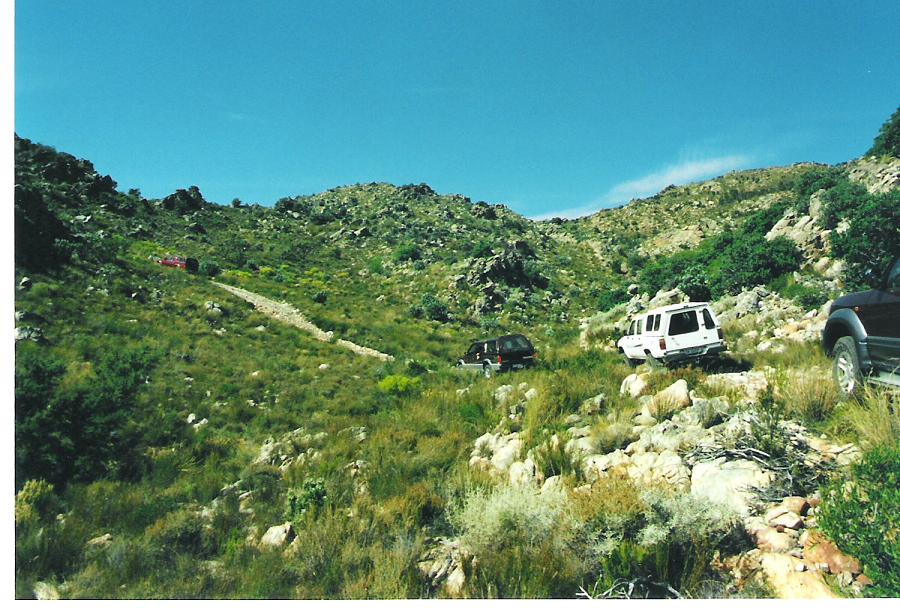
The route renders a variety of driving conditions, giving good exposure to different techniques. When we reach the top, we stop and relax, with sponsored drinks being shared. There is a marked absence of any alcoholic refreshments, which I thought was rather fitting for the occasion.

We proceed again. Shortly thereafter we come to a split in the road. The board says: “Experienced Drivers” with an arrow pointing to the right. I want to aim for the sissy route to the left, but realise that I will be causing virgin tracks on that piece of road. So I turn right. Off to the gallows you go, boet. This brings us to Diepkloof.
In winter this would be a river, but now it is a dry ravine, with very steep banks. From this side the descent is hard sand. Phil positions himself to indicate to drivers which line to take. Because of some axle twisters, the vehicles invariably end up with a front wheel in a hole, with the rear of the vehicles protruding upwards at peculiar angles. Rather impressive, a bit like a Great Dane doing his thing against a tree, you know.

On the other side the very steep ascent requires a slow endeavour in low range second gear. However, adrenalin seems to get the better of some of the drivers and they charge up the bank with screaming engines and spinning wheels. The first two vehicles take the incorrect line, do a bit of a hop & skip, and narrowly miss a bush standing nearby, minding its own business. Phil places a rock as a marker to improve the aim of the next drivers. Keep right of the rock, he instructs.
Eventually it’s my turn. I get in my bakkie, ref the engine, spit through the window, put my camel behind my ear. Then I wind down the window, spit again, this time through the open window. I remove the camel from behind my ear, put it out and put the camel behind my other ear that has not been burnt yet. Then I grab the door with my right elbow……
No, I’m very sorry. I’m lying through my teeth. It did not go exactly like that.
It was more, like, you know, sort of, after slipping away to answer Mother Nature’s rather nervous call, it is my turn. My mouth is dry. Very dry. My hands and knees are shaking. This is, of course, not a bad thing. Given the absence of ABS brakes my shaking right leg works perfectly for cadence braking.
I just do exactly what Phil says. He’s supposed to know what he’s doing, and I decide to simply put my faith blindly in his expertise. Eventually I get down the bank, up with the bank at the other end with the big six grumbling reassuringly, it’s like music. Piece of cake. I nogals felt like a pro, admittedly not due to any particular skills on my side. Arriving on the other side I’m reluctant to let go of my steering wheel. As long as I can clutch the wheel no-one can see the tremor in my hands.

The last difficult leg is a sandy ascent that starts off with a sharp turn to the right, preventing you from picking up a great deal of speed. The very simple principle of letting your tyres down is illustrated sufficiently by the fact that the two vehicles that did not let their tyres down …
Field Repairs
[Also in Afrikaans @ https://pgjonker.co.za/?p=126]
Reflections of a non-mechanically minded traveller
[Published as a letter in LW, April 2010]
In his article Softroading the Dunes (LW, March 2010) Johnie Jonker writes: “Predicting what other spares could be required would at best be a hit and miss affair, so forget about them and rather think on your feet when faced with a problem.”
Now thére lies a slight problem for the likes of me. I have difficulties changing my bakkie’s wheels, nevermind thinking on my feet when a problem arises. So at all times the first thing on my planning list is to identify a mechanically minded genie to take along to do that “think on your feet” thing for me, should something go wrong.
A few years ago we were three families that embarked on a trip to the Richtersveld. It was my maiden 4×4 tour. I even boasted an oversize high-lift jack that someone dumped at my yard. However, when everything was packed and we started looking for a place for the high-lift jack we decided that (a) none of us had space for it, and (b) we’d rather try to stay out of trouble. So we left it at home. Maybe this gives an indication as to how serious we intended to do the heavy stuff off-roading.

[Picture: Frikkie, Pieter, PG]
Now, it was imperative for my friend Frikkie to go along on the tour. My “think on your feet” genie. Shortly before the trip I had a burnt valve repaired on my bakkie. The 1000km mark, on which the obligatory retorque had to take place, would happen at McDougal’s Bay. So we rented a house with a lock-up garage so that Frikkie could do the retorque of the engine on the morning before we left for Richtersveld.
I watched in awe as this was done. Now and then I would hand Frikkie a spanner on request, normally managing to correctly identify the requested spanner on the third attempt. It later turned out, however, that had the figures in foot-pounds instead of Newton meter, and with the result that the whole retorque exercise was one in futility which eventually had to be done again by the garage who did the initial job.
Later on the tour, somewhere in the middle of the Richtersveld National Park, my bakkie’s remote control stopped working due to the batteries having run flat. Fortunately another travel mate, Pieter, came to my rescue with an old set of batteries that he had in his cubby hole that did the trick.
However, what Frikkie did not tell me was that, while I was breaking out in panic stricken sweat, he already figured out where he can cause a short with a screw driver to by-pass my immobiliser.
After a rather enjoyable stay in the Richtersveld, we left the park at the Helskloof gate. At the gate Frikkie noticed that he had a brake oil leak on his right rear wheel. He was not unduly worried about is. Very few things of a mechanical nature can unsettle Frikkie.
We visited Khubus (oeps, here I have my spell checker in a frenzy). I thought Khubus looked a bit like Paternoster, only a lot further away from the sea. Before Lekkersing we turned off for Eksteensfontein. At Eksteensonftein we stopped again, and Frikkie realised that the leaking oil is not brake oil, but diff oil. Now I ask you, how did he know that? Did he test the cultivar or something?! But Frikkie was still not too worried.
From Eksteensfontein we travelled on an increasingly worsening corrugated surface. Later Frikkie stopped to inspect a knocking sound coming from underneath his bakkie. He identified a loose rubber on his exhaust and fixed it. He was not worried.
However, the knocking sound persisted, and just before the Helskloof Frikkie stopped to inspect again, but could not see anything wrong. Nothing to worry about, he said.
Just as we exited the Helskloof, fortunately on a straight stretch of road, Frikkie noticed in his side mirror that his rear right wheel was now running next to the bakkie, instead of within the designated space for said wheel. It turned out that the half shaft had been pushed out of the diff, and had pushed through the brake drum. I’m not sure whether Frikkie was now worried, but by then I thought he actually should be.

Pieter left with the rest of the crowd to go make camp at Peace of Paradise and returned to assist with the repairs on the wheel.
It turns out that the last guy who serviced Frikkie’s Hilux did not replace a circlip. The half shaft’s splines looked like they were melted. On the other end, the shaft was forced through a bearing and a further metal ring that was supposed to keep it in place. It forced the brake drum (and thus the wheel) out.
I had no idea what was wrong, that is now apart from the obvious fact that the wheel fell out. I also had no idea what should now be done, other than to call some sort of emergency number, if we only had reception. I have to confess that I was very relieved that this happened to Frikkie’s bakkie instead of to mine. However, through all this Frikkie remained unfazed, setting to work and instructing Pieter and me what to do. Admittedly, I did not do much, but I do have my moments offering good company, you know.
The wheel bearing and metal ring were heated up with a Cadac utensil, whilst lubricating it with brake fluid. We then took turns hammering it back into position. [It was a lot more difficult than it sounds here, believe you me.] The half shaft got inserted back into the diff as far as it would go (which was not as far as it should have gone) and the wheel nuts had to do the rest. One of the six wheel nuts was damaged, though. The drive shaft was removed, leaving the bakkie as a front-wheel drive. The feeder pipe for the brakes took some effort to get it hammered so as not so spurt out brake oil.
Eventually, after nearly 5 hours, and with not a single vehicle passing us, the Hilux was …
Drifter?
[Story also in Afrikaans @ https://pgjonker.co.za/?p=89]
It was a beautiful morning at Brittania Bay. The water was extremely low. We are loafing around, enjoying the sun and the water. More the looks of the water than the feel of it. The West Coast water is reputedly chilly, even in summer.
A few young men arrive with a jet ski on a trailer behind a Mazda bakkie. They reverse the Jet Ski in the water to offload it. Because of the water being so low they have to go in rather deep just to get to the water.
Soon the Jet Ski is up and running, and taken for a spin just to check that everything is working fine. Everything is working fine.
In the meantime it appears that the water has just reached its lowest point, and the tide started to turn. The young men later realise they should better move their Mazda to higher ground. But now there is a slight problem. The bakkie is bogged down in the sand with the trailer still hitched, which does not make things any easier.

I jog over to my bakkie to assist in the recovery, but get beaten to it by a guy in a Landrover Defender. I contribute my brand new 3-tons breaking power rope for the occasion.

The chap in the Landrover tells met this is a kinetic strap. I inform him that it is not the case. No, trust me, it is a kinetic strap, he insists. Not wanting to get involved in an argument I leave it there. The recovery is approached by the guy in the Landrover as if it is a kinetic strap. I wince with every attempt.
I know nothing about recovery, but I have read before in Andrew St Pierre White’s book that it is a good plan to open the bonnet of the vehicle being recovered, just in case the recovery vehicle’s tow bar might come off. As the rope is indeed hitched to the tow bar of the Landrover I open the Mazda’s bonnet, just for in case.
After a number of attempts the Mazda is still right where it was when we started the recovery. The trailer is now unhitched to lighten the load. The Landrover tries again, but also starts to get bogged down.
Then, by a happy coincidence, the next attempt by the Landrover coincides with a large wave that lifts the Mazda’s rear wheels from the sand and sets the Mazda adrift, and whala! The Mazda is out.

I assume this is why they call it a Drifter?…