Category “English – Wheels stories”
Day trip – Boland and Klein Karoo
Well, actually a two-day trip.

[Source: Map data ©2014 AfriGIS (Pty) Ltd, Google]
Franschhoek
We set out for Montagu on the Saturday morning and decided to go have a look what’s happening at Franschhoek.
On this morning Franschhoek sported French names, French restaurants, French flags, French berets, French rugby or soccer jerseys, pretty much everything French but French itself. Or maybe there might have been a few Francophones, I just haven’t heard any of them. The reason for this French extravagance was the Bastille Festival held over two days.
The history of Franschhoek dates back to the revocation of the Edict of Nantes in France in 1685 in terms whereof Protestantism was outlawed. Some 277 Huguenots fled France, and were given land by the Dutch government in the Cape after their arrival there.
Once a year Franschhoek celebrates the Bastille Festival . And this was that weekend. [Vir ‘n effense ander blik op hierdie uitstappie in Afrikaans.]
We were fortunate to arrive early enough to get a nice seat at a side-walk café to have a morning coffee. The athmosphere was festive.
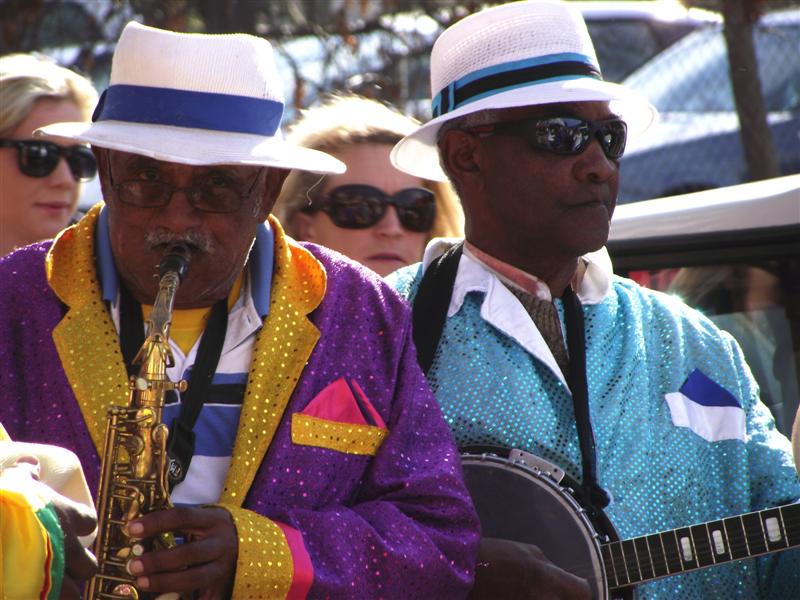
Being en route to another destination we did not spend much time here. Better luck next year. We’ve been there long enough, though, to sit and watch the first marching band coming through town, right in front of us.

Taking some back roads we managed to escape a by then rather busy town to go over the Franschhoek pass, leading to Villiersdorp. Franschhoek makes a wonderful sight looking down from the pass.

Outside Robertson is the Affieplaas Padstal. For years I have driven past this road stall, but never got around to stopping to take a picture of these blokes. Today I had time.

McGregor
Next destination, McGregor. The area drew the first farmers in the late 1700’s. Only in 1862 was a town proclaimed and by 1905 all plots had been sold to 19 owners. The town is pretty much a road to nowhere, so there is no traffic passing through.
Arriving at McGregor we tried to get a bit of a feel for the town. I found the corner of the town (literally).

This was an elevated spot from which I could overlook downtown McGregor.

From there we moved on for lunch at Tebaldi’s. The restaurant is situated in a part of town where the whole block appears to have been converted in a sanctuary where you can do meditation, swim, eat, stay over, or do whatever peaceful activity takes your fancy.
The street lamps struck me.

The town was very quiet. I did notice, though, that the police appears to be actively keeping it that way with the patrol van doing its rounds probably twice in the time we were there. I do not believe they would establish an emergency response unit for this town soon.
After lunch we took the road back to Robertson as we came. I noticed that Robertson also advertises their “Slow Festival” coming up soon. It is a food and wine festival with the catch phrase “slowly made, slowly enjoyed”. Well, I guess any excuse for a festival should do.
Montagu
Our destination was Montagu. We visit there often, but this was the first time we stayed in a guest house in town.
Aasvoëlkrans offered rather nice accommodation.

Our suite overlooking a horse pen.


Judging from the guest book it will appear that a great many German tourits find their way to this guest house.
A great breather of a weekend, within 180km’s of home.…
Vleesbaai 4×4
By PG & Johnie Jonker
It was a clear sunny December morning when we arrived at the Vleesbaai 4×4 route for a bit of dune driving. Whilst doing the preliminaries more vehicles arrived.
Eventually 7 vehicles set out on the route, following the Colt DC (petrol) leader vehicle. I was a passenger in bro’ Johnie’s Tiguan.
At the first real dune those who still not had their tyres deflated did so.

Being a bit of a techno-freak bro’ Johnie made an adaptor that could keep his camera in position on the roof of the Tiguan to get some good video clips.

The first obstacle was a steepish dune that required some speed to make it over the top, but over rather uneven ground. This somehow caused the Pajero’s cowl to become unstuck. Fortunately the handy guys in the crowd could get things up and running in no time.
In the meantime the rest of the crowd was getting the hang of things, rushing up and down the dune. One of the drivers got a bit carried away with his Discovery V8. He enjoyed himself so much that he sommer came back the way he went – forgetting that this would but him right in harm’s way of someone charging up the blind hill of the dune! Fortunately no harm done.
However, shortly thereafter I noticed steam coming from underneath the bonnet of the V8, so I’m not quite sure that no harm was done there.
I thought the Tiguan was doing rather splendid given its demeanour as a bit of a town’s car, rather than a serious off roader.

Some of the obstacles proved too much for most of the vehicles. At one of the dunes only the lead vehicle and the next vehicle could make it to the top. None of the rest could, although not due to lack of trying. It made for some spectacular viewing.
Only one vehicle did not attempt the obstacle. The gentleman with a Touareg told me that he had a few thousand Rands worth of repairs done to his vehicle after he damaged it on that exact obstacle only a few weeks earlier.
At this stage I was having my doubts about the Drive Out Magazine’s difficulty rating of only 2 – 3. Watching, and listening to some of the laborious efforts of the engines of some of the vehicles, I thought it might warrant a slightly higher rating. But then again, I’m not really into heavy off-roading, so maybe it’s just me.
Now just for the sake of perspective I have to insert this picture.

The angle is not quite correct, but picture you’re travelling slowly down a dune, minding your own business. In front of you is this Defender. The gap between the Tiguan and the Defender is becoming smaller at an uncomfortable constant speed. The reason being that, although we are only driving at 30km/h, the Defender is doing 25km/h.
This should really not be a problem. I mean, as is the custom, the Tiguan is fitted with brakes. So the application of this fairly basic bit of technology should solve the problem.
Not so.
I will let Johnie take up the story from here, as it becomes slightly technical.
“My VW Tiguan suffered considerable front-end damage due to the failure of the ABS system to stop the car, resulting into tailgating the vehicle ahead of me. Although the brake pedal was depressed, gently initially but with more force [it went along with some verbal encouragement as well – PGJ] when I realised the car’s braking was ineffective, the only response was the continuous kicking of the pedal under my foot for the time it took to run into the vehicle ahead.
This specific part of the route was a gently winding descent on a sand road – not overly loose, at trailing throttle – the vehicle in front was probably travelling at 25 km/h and the Tiguan at 30 km/h at the moment of impact.
The top of the bonnet was crushed by the rear door mounted spare wheel of a Landrover Defender 110, which did not suffer any damage. [So now we know why it is called a Defender. The gentleman in the Defender was unaware even of the impact! – PGJ]
Once the radiator had been clipped back into position to stop the cooling fan wearing away the broken air inlet ducting and makeshift repairs were made to enable the bonnet to latch, we travelled further.
The problem appeared to be the ESP. As the ESP resets itself to ON every time the ignition is switched off, it is required to disable it before starting off each time. This was diligently done for the preceding 20 engine starts, except for this one, seeing that it was going to be downhill all the way on a relatively solid sand road. Tyres were deflated to 0.8 bar, giving a good footprint/grip on the surface.
Following the collision, I decided to verify whether the situation could be simulated or whether it was a once-off occurrence. On the return path to the route start, I reversed downhill over the same route with ESP ON, and then applied the brakes, with the same result – the pedal just kicking under my foot – this time stopping the car with the parking brake.
I then disabled the ESP, repeated the same exercise, and the car stopped immediately.”
In any event, the sensation of sitting and watching in slow motion how you hit the car in front of you is a riveting experience, although not necessarily one that one would like to have a repeat of.
The result of the impact on the Tiguan was as follows:

After a bit of tinkering on the car back at the Gouritsmond Caravan Park it looked like this.

Not quite as be fore, but at least the bonnet could close again properly. After a subsequent visit to the panel beaters it was restored to its former glory, which looked even better.
So, lesson learnt: when driving off roading in a car with all sorts of high tech gizmos, maybe it’s best to get out and take pictures from a distance?
Alternatively, RTFM [read the freaking manual] beforehand.
PGJ…
Magic Klein Karoo
On a farm outside Montagu.
It is a mountainous area, with magnificent views.

Other things also amuses small minds.


Water is sourced from a natural spring. Pretty remote, and it takes some planning to get to the spring. So the farmer decided to make a road to get there.
Not quite your ordinary road. And albeit a road, it would be life threatening traversing it with a vehicle without low range.

The road takes you down into a ravine.
Here water comes from a rock. Unlike Moses there is no need to hit the rock. You just scrape away the moss, and out comes the water.

From there you walk a distance to get to the spring. Well, not really to the spring, but to a pool into which the spring deposits its water.
On your way there you find some interesting rock formations.

And more.

Looking back.

And then you find this pool between the rocks. At the far end where the water comes in, moss has made it a slippery slide. Once you let go, you have no control. Gravity takes over.

Careful, grandpa, let me hold your hand.
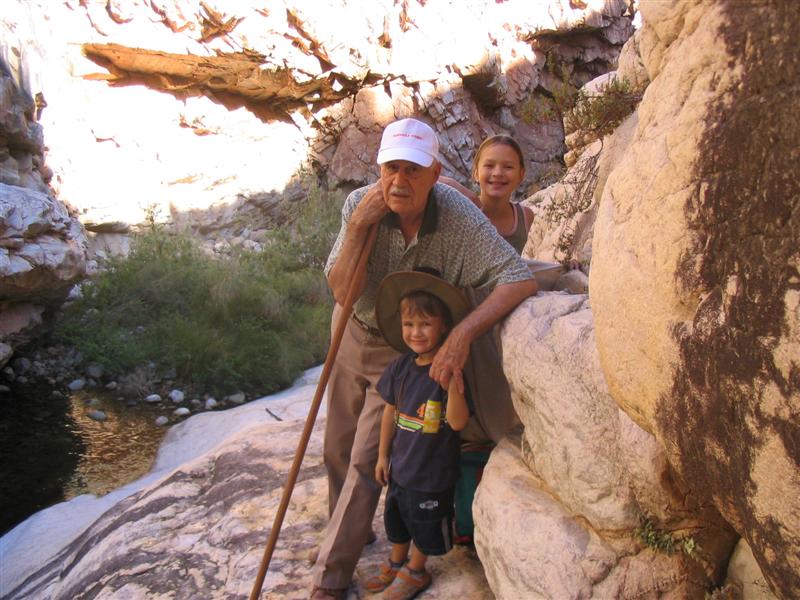
And then back up again.
 …
…
Stettyn
By PG Jonker
[Published in Leisure Wheels, March 2011]
One Saturday morning four families (including us) met at the Huguenot museum in Franschhoek, en route to Stettyn, via Villiersdorp, for a bit of 4 x4 and a sleep-over in nature, while putting our vehicles to the test at the same time.
Setting
From Franschhoek we travelled in convoy on the twisty road to Villiersdorp. The Stettyn 4×4 trail is located on the farm Stettyn between Villiersdorp and Worcester, at the foot of the Stettyn mountain range. The trail provides some nice challenges, we were told, and the views and terrain are magnificent, with a variety of fynbos and proteas.
Arriving at Stettyn, we found our way by following the directions to a nearby silo, which served as the admin building.

Inside the silo we signed ourselves in, unassisted.

On the walls inside the silo there are aerial pictures of the 4×4 route. They show the 12 hairpin bends you will encounter on your way up a climb that will take you 1300m above sea level.

Up, up and away
After a good brunch we deflated our tyres, and off we went.

It is a steep climb, and we travelled mostly in low range, second gear.

After an hour my bakkie’s temperature gauge started climbing too. We stopped a few times, but none of these stops made much of a difference to my bakkie’s temperature. The route is such that you cannot simply pull off and let the others pass. If you stop, no-one behind you can go anywhere!

So I kept going with the grumbling of the big six 3.4 litres in my ears, and the temperature steadily climbing (mine too).
Fans
I later switched the air-conditioning on, as this should activate the electric fan. However, after a short while I noticed matters were getting worse, so I switched the air-con off again. Eventually the temperature gauge got to the red line, when suddenly the temperature started dropping dramatically down to normal. I’m not sure whether it was because we entered the shadow of the mountain, or whether the viscous fan actually kicked in. If it was the latter, then it means that the viscous fan only kicks in once the needles starts nudging the upper limits of the temperature gauge.
I later found out that my electric fan had actually been burnt out and did not come on when I switched on the air-con. Which explains the rapid deterioration in temperature once I put the aircon on, instead of improving matters! I had to have this fan replaced afterwards, but I asked the auto electrician to add a toggle switch so that I could activate the electric fan without switching on the air conditioner. I’ve needed this device only once since, fortunately. That was in Chobe a few years later when I kept my bakkie running all the time because I was not sure how quickly an elephant could cover 50m! I also had the viscous fan replaced after the mechanic had the bakkie idling for a long time without any hint of the fan kicking in. So I’m still not sure whether it might actually have been working on the Stettyn trip, but only kicked in once the gauge reached the red line.
These days I’m not taking any chances. If that gauge just looks like its going up, I switch on my electric fan, simply because I have it.
Beating the bends
But back to the driving. Low range seems essential on this route. Steep inclines and rocky areas sometimes cause wheel spin that requires a diff lock to retain traction. At two of the hairpin bends the vehicles couldn’t turn, as there was not sufficient space, so we needed to do the bit that followed in reverse. At this spot, the Isuzu was coming up the incline, with the Toyota moving away from the camera – quite a classic scene, but you needed to be there to appreciate it.

The scenery was magnificent. The Brandvlei Dam could be seen in the background for kilometre upon kilometre.

Judging from the time display on my pictures, it seems that it took us some three hours (with stops) to reach the camping site 9km from the starting point. We eventually reached a point where we were able to look down at the campsite.

We made ourselves at home and enjoyed the facilities.

From the map in the silo office, we knew there was another campsite a further 3km away from where you can climb to the top and see Table Mountain in the distance. A rock cabin has been built there. However, we only went as far as the first campsite.
The camp site offered running water – from a tap and hosepipe, that is, apart from the stream running past the camp site.

A roofed area with cement floor and a low wall of about a meter high offered good shelter to kuier, with braai facilities. Proper ablution with donkey heated water also enhanced the experience to a very civilised level.

Stettyn is abundant with lovely varieties of fynbos. We didn’t see any animals, but were told that there are duikers and klipspringers and other antelope around. Leopards too, apparently, but we were not actively looking for one.

A game of touch rugby was set up with the ‘elderlies’ against the teenagers. It should be mentioned that the game was lost by the teenagers (rather than won by the ‘elderlies’), in spite of one of the ‘elderlies’ having been on his way to have a second hip replacement done!
By late afternoon the clouds had gathered around us, and by evening we found ourselves inside a cloud, leaving everything foggy and wet. Although it was not raining, everything got soaked.

This, of course, could not deter us from having the custumory braai the evening.
I was becoming slightly concerned about the weather. We left next morning in a thick mist (or was it a cloud?). For the first part of the return trip, visibility was severely restricted by the fog.

Whereas it had been very hot the previous day, it was now rather chilly, and in the conditions there was not much reason to stop.

The trip down, therefore, went somewhat quicker than the climb, but once again …
Beaverlac and Montagu
By PG Jonker
We had one of those extremely long weekends in May 2008. With a view on the upcoming tour to Vic Falls we were planning we decided it’s time for a trial run.
We were a party of three vehicles that hit the road to Beaverlac, just North East of Porterville. We took the back roads.

Just past (North of) Porterville is a worldwide renowned hang-gliding spot. For the benefit of the hang-gliders they tarred the little mountain pass.

It looks like nothing, but believe me it is nogal steep up there.
On top of the world.

In winter the land in the background become lush green wheat lands. Quite a sight then.
Some of the attractions at Beaverlac are the pools, and the foofy slide – hence the rope.

Of course we also did the camping thing, as was the purpose of the exercise.

At the fire:

We only stayed for one night, and thereafter left for Montagu. Due to a slight error in judgement we ventured into Montagu dorp on the Saturday morning.

Payday, Holiday, Easter, all compounded to make it a very busy morning.


At the end of the weekend we headed back home, and waited longer than a hour just to get through the Huguenot tunnel!
Nice weekend, though.
PGJ…
TO HELL AND BACK
By PG Jonker
How it happened
Over a cup of coffee Pieter let it slip that he had a caravan site booked at the Calitzdorp Spa. I did not know that Calitzdorp had a Spa. Actually, I did not even know where Calitzdorp was. Nevertheless, I then promptly booked a site for my family as well. After all, we had a brand new second hand tent that had to be taken for a test drive.
Packing
Packing for a tour is not per definition ‘touring’. However, in this case the packing requires some comments. See, this new tent of ours was a rip stop dome with a “diner / extension”. Apart from the day that I took delivery of it and pitched it just to check that everything was there, this tent had not been camping with us before.
Given the size of the tent with extension, though, it was clear from the outset that there would not be space for our fold out mattresses. In fact, there would not even be space for the “diner / extension” if we do not take a trailer along which we did not have. Out of curiosity I weighed the equipment, only to find that the whole package weighed a cool 70kg’s!
Standing back to inspect after packing our stuff the Friday evening before our departure, it appeared that I might, with a bit of rescheduling, get that diner/extension in as well. So the packing started all over again. Everything had to come out of the double cab again. Rather proud of myself I managed to get the complete tent with the extension in. After all, the whole idea was to see if we could get this right before the upcoming tour to the Kgalagadi Park a few months later. All that remained was that “last few things” that comes in the morning of our departure. Experience have taught me, though, that this “last few things” often gets very near to breaking the camel’s back!
Calitzdorp spa
We departed early Saturday morning. Twice. At Kraaifontein, about 10km’s away from home, we had to turn around the switch off an electrical appliance. The second attempt was more successful.
Calitzdorp is far from Durbanville, especially if you later find that your eyes have become watery because of a need to visit the restroom. To make matters worse, the road signs did not play along at all. By the time we should have reached Calitzdorp, the road sign said it was still 10km’s away. When we eventually reached Calitzdorp, we learnt that the Spa was still 20km’s off. And when we eventually reached the turnoff to the Spa, there was yet another sign indicating the Spa to be still 7km’s away! Paah! Eventually, though, we got there.
Pitching tent
It took a while to pitch the tent. Quite a while. No. Let me rephrase. It took a ^&*($@# long time! By the time the last tent peg was in, it was 15h00 – just in time to go find a TV to watch the Tri-Nations rugby test between South Africa and Australia. The test, I am happy to report, was won by South Africa, albeit with a small margin.
It was a wonderfully quiet full moon night. However, by 21h00 one got the feeling that your denims are just too cold against your skin for comfort. Pieter warned that it became rather chilly the previous night – they came a day earlier. Now how cold exactly, we asked. Quite cold, reckoned Pieter.
It turned out to be -1 ° Celsius. Cold, man. Like in Kimberley-in-the-army-in-winter kind of cold. Eish! You can put more clothes on, but it only prolonged the process of the cold eventually getting into your bones – it cannot prevent it. This is not, let me tell you, my idea of camping.
During the course of the night my wife did her rendition of Racheltjie de Beer , checking on the kids every now and then to see if everyone is still alive. And every time she finds yet another garment from a bag to throw over us. By 05h00 the next morning we were fighting against the awake. We did notice to our relief that and could not be too long before the sun would be out.
Swartberg
Getting started – literally
Sunday morning eventually broke. The plan was to go over the Swartbergpas [‘Black Mountain pass”] and to visit Die Hel. [“The Hell”]. But first we needed to get the kids out of bed.
Some of them were crying because it was so cold. I could relate to that – I pretty much felt the same. Everything in your body hurts because of the cold. The windscreen of the Mazda was frosted up. I chose not to use warm water to improve things for fear of cracking the windscreen. So I decided to rather get the engine running and to drive through the caravan park whilst getting the heater to defrost the windscreen. However, because of the cold the remote control would not work. So I had to unlock the door with the key. As expected, the quietness of the early Sunday morning was shattered by the wailing of the alarm. It took a while to get that deactivated.
Because of the fact that the choke of the bakkie [for those not from SA, a bakkie is a light pick-up truck, or a utility vehicle in Ozz] was giving me problems, I had that made inactive some time before. I will not take you through the process, but suffice to say that it took some convincing to get that 3.4 litre petrol engine started without a choke in sub zero temperatures.
I took Chris-Jan, then 17 months old then, with me in the bakkie. At least it was mos supposed to be warmer inside the bakkie than outside. Not so. With the frost on the windscreen I had no choice but to wind down the window and hang out of the window to see where I was going. So, whereas in theory it was supposed to be nice and warm inside, it took an inordinately long time before that point was reached. In the meantime Chris-Jan and I had to contend with what I believe the weather station …
Buying Cars
By PG Jonker
Some people buy cars regularly. They say if they don’t they fall behind too much in how much a new car will set them back. I also buy cars regularly. I trade my cars when they are 18 years old.
I also read the CAR magazine regularly. OK, this is now more regularly than buying a vehicle; more like in once a month. Well, actually a few times in that month. At some stage I lost interest and suspended my subscription; the prices of new cars were (still are) simply too much to generate much enthusiasm for a new car. However, it was a bit like trying to stop drinking coffee. I get enormous headaches that force me back to the black stuff soon. It was a bit of the same with my CAR magazine. So I decided to surprise my wife with a fresh subscription to CAR-magazine for her. Just as a token of appreciation for that tea set she bought me for my previous birthday (that was after I bought her an electric drill for hers).
In any event, I found that if I hold on to my CARS (the magazine, that is) long enough, it becomes more and more relevant. For instance, I still revisit my 1984 CARs for the road test of the Range Rover of yore. Or more recently when we had to start shopping for wheels. This was somewhat out of sync with my usual pattern, as my bakkie is now only 12 years old and still has at least 6 years to go. But then again, I did not sell my bakkie. The newly acquired wheels were to become an ad on to the existing fleet of two vehicles. That’s what happens when (a) your son finishes school; (b) enrol at the Tek; (c) passes his driver’s license after the third attempt, and most importantly (d) your wife tell’s you to go out and buy a car.
Now this is actually great fun. I really enjoy searching for a car. I just don’t like going out to actually buy one. The thing is it stretches my nerves and my budget to the utmost (the two seems to have an umbilical cord connecting them), resulting in panic attacks that last for a few weeks. So I need to safeguard myself by, amongst other things, not doing a private deal.
Top of the list, Plan A, was a first generation Kia Sportage (1999 – 2003). A leisure vehicle that can carry 5 plus luggage, and can serve as a back-up to tow the caravan. Yes, I do realise that speed would not have even entered the equation. However, the Sportages I could find that were in close enough proximity to warrant to go and have a look were all hugely overpriced. And those that I could find at dealers touched the 200 000km’s.
So I scaled down to plan B. Daihatsu Terios, first generation. There are very few of these around. I found two at one dealer, but by the time I showed some interest, they were both sold. At the same time I also started looking at a Fiat Panda, but discarded this option as being too small (although the Panda is wider than the Terios).
By this time a few weeks have passed, and my wife was beginning to suspect that I was just playing around to rather not buy the car. She was not entirely wrong. Eventually we fell back to plan C: A non-SUV, hatchback, that can sort-of serve as a back-up family car, but not required to tow the caravan. I also eventually found an online data basis that seemed to cater more for dealers than private sellers.
Now, used car sales people are very often the butt of ugly jokes. Just like people always seem to think that lawyers are a bunch of skelms, which, of course, is absolutely not true. Trust me, I know.
Anyway, it reached the point where I reminded my wife of that Mercedes we started saving for in 2002. I told her I think we can now buy a Mercedes. She was very excited about the idea of a new Mercedes, but I had to break the news to her that I meant that we can now buy the 2002 Mercedes that we started saving for in 2002.
Enter Concorde Cars’ Angie and Gavin Alford and a sexy 2002 Mercedes A160 with 87000 km’s on the clock. And believe you me; all three of them were very nice. As a result we now have a brand new second hand A160 (of which I incidentally still have the CAR road test because of me hanging on to my old CAR magazines.)
Now I do have a bit of a resistance to bling. However, I overcame that by deciding that this particular three-pointed star cannot count for bling. Amongst other things for the following reasons: (a) it is shorter than a Fiat Uno (I kid you not); (b) it is 8 years old; and (c) it costs less than a late model CitiGolf.
After a week the A160 went back for a lube service and the niggles list that I put together. I don’t usually consider myself to be a demanding customer, but I thought it incumbent upon me to be as critical and thorough in my estimation of the car so that all problems might be sorted out. I must admit, I was somewhat embarrassed handing over the list to Gavin & Angie. In my defence I should ad that I was at pains to differentiate between repairs I considered that had to be done, and the rest of the list, which I preferred to call “observations”, with the innuendo that those niggles are not expected to be repaired.
Well, lo and behold, the car came back with even the “observations” attended to. Gavin clearly did more than just walk the extra mile.
I’m telling you, used car sales people are just misunderstood. Just like lawyers.
PGJ…
Truck calamity
By PG Jonker
Wednesday, September 11, 2006
At 22h39 my mother in law sat around her house, minding her own business. The house is adjacent to a general dealer and an offsales. Then she heard a noise. Loud. It sounded like a helicopter. The noise lasted for a few seconds, and then something hit the building with a massive bang. A chopper fell on my house, Anita thought.
She went out and walked around the building to the front to see what has happened. It turned out that a truck driver with a load of fish on his maiden trip to Stompneus Bay miscalculated the last bend in the road, 200 meters from his destination. What Anita heard was the noise of the exhaust brake, and then the bang as the lorry overturned 270° and went right through the side wall of the shop. 
Tragically, the driver was killed on impact. No-one could get to him for hours until they got another truck to pull his truck out of the shop. By 03h00 the other truck arrived. However, it was evident that the stricken truck would not leave without the building. It took a few innovative plans to get it out of the building without damaging the building further. Only then could the driver’s body be removed.
By 09h00 the tennant of the shop already started with emergency repairs to the walls. Later the local Grade 2 class arrived in a neat row on an educational tour to see what it looks like when a truck goes through a building.
Workers from the nearby factory came with smaller trucks to work away the tons of fish that were scattered around.


While they were busy the school came out. Two lads from the local primary school came walking by.
“Hey, it stinks, né,” observed the one.
“Ja, just like old folks’ bums,” confirmed his friend.
Only by late afternoon the mechanical team from the SA Police Services finalised their investigation. Thereafter the rather impressive exercise followed to get the truck back on its wheels.

By 14h30 the truck was back on its wheels. By 17h00 the rented security guard arrived to watch over the shop for the night.
On a sad little heap I found the personal belongings of the truck driver. A coffee bottle, some extra clothes. And a cap with the insignia: “Skoonma se gaai” (a humorous / friendly version of “My mother-in-law’s a*se”).
PGJ…
I want my wheelies!
Having the wheels come off
By PG JONKER
On a previous occasion we went camping with a friend’s caravan at Gouritsmond. We then decided to get one of those canvass tents with an extension. It works well, but we found it to become a bit crowded with our own three children and friends who make themselves at home in the extension which is supposed to serve as the kitchen and dining area.
To top it, on the day of our departure from Gourits we found that the tent and its fixtures have grown so remarkably that we had to leave a few things behind. There was simply not enough room for everything. So we decided to reconsider our camping outfit in favour of a caravan. Enter Frikkie and his caravan.
With my friend Frikkie’s blessings, we then opted for a year of Gourits camping with his caravan. One of those bulky Gypsey’s with the fixed roof of about 1974 vintage. So we set off for Worcester to go fetch the caravan. That would have the benefit that, by the time I depart for holiday, I would have towed the caravan for some 90km’s, so I should have the feel of it.
Frikkie is a handy guy. On occasion he lost a wheel on his bakkie while touring the Richtersveld. Unfazed, he simply did a field repair job on it and proceeded (see https://pgjonker.co.za/?p=118). He is a guy with a plan for any eventuality.
Frikkie’s caravan is stored behind his house. To get it out requires a bit of an exercise. On the face of it, it is simple. You just drag the caravan out from behind his garage. Go around the garage, up with a little slope which brings you under his carport, around another corner and you are on your way to his front gate. Easy as that. So I thought, until the morning we arrive at Frikkie’s place.
The process summarised above is pretty much correct. The problem, though, is that the carport referred to is a bit on the low side. The caravan cannot pass underneath it. But that is not a problem for Frikkie. He made himself two small steel wheels that fit on the caravan. The wheels are small enough to lower the caravan just enough for it to pass underneath the carport.
So the first exercise is to, as stated before, drag the caravan out from behind the garage and up to the point where it is about to move up the incline to the area underneath the carport. Up to this point the caravan is still shod in his standard wheels.

Now we (OK, actually Frikkie does this) remove the standard wheels and replace them with the small steel wheels.

Once this is done, the caravan is pushed up the incline. Once you are on even surface you are met with one of the legs of the carport that is smack in the middle of where you need to pass with the caravan. That is no problem. Frikkie had a plan. This leg has a swivel point at the top, and the bottom can be undone from the floor where it is fixed with a bolt. Now someone just keeps this leg out of harm’s way, and off goes the caravan. Once you have passed under the carport, the leg gets installed again.
Now the process of refitting the proper wheels follows.

And wala! One hour later you have managed to move the caravan a full 20 meters, and ready for action.
Frikkie has since sold his caravan. I guess his wheels came off about this whole process.
PGJ…
Trails and Softroaders
[By Johnie Jonker]
[Adapted version published in Leisure Wheels, June 2010]
A while back, a trail I wanted to do – advertised as Grade 1-2 in Drive Out magazine – was indicated as Grade 2 – 4 on the brochure. This was a substantial difficulty “upgrade”, as the latter requires low-range. Whether this was done intentionally or not, the end result remained the same: Softroaders were excluded.
As extensions of their personalities, softroader owners could be divided into two categories:
Owner 1: Wants to take his car places and show it to crowds, where
Owner 2: Wants his car to take him from crowds and show him places,
the latter group being in the minority, in part (largely?) due to insufficient sharing of experience.
In a thread titled “Where did your Softi take you” under the Softroader section of the 4x4community.co.za forum, a reader comments on pictures of a Forester on the Witsand dunes: “Never knew the Forester was capable of that”.
Regardless of whether it was a Forester – it could be any other softroader for that matter – this presents the core of the problem. Not the fact that the reader did not know a specific vehicle’s capabilities, but rather, if he – a softroader enthusiast – did not know this, how many trail owners would?
To change this outcome is up to the softroader community itself, i.e. for those with the higher risk profiles to experience (sometimes the $hard$ way) their specific vehicles’ capabilities, then SHARING this on a public forum.
Most vehicle brands have their own forum where owners talk LR, Toyota, Pajero, etc. But as the active softroader community is very small, we can ill afford exclusive (selfish?) loyalty to own-brand forums, only preaching to the converted. You may have a particularly capable softroader/modification and could be sharing valuable information, useful to the newbie and the fed-up owner of a poor one alike.
Armchair polemics between proponents of the “low-range or not” brigades are mostly speculative and of no use, as it invariably ends up with both camps suggesting that the other “should know their place”. It is doubtful whether more than a handful of these “expressionists” have in actual fact driven both types of vehicle in applicable terrain.
Therefore, to the more adventurous softroader that actually takes his vehicle off the beaten track, I appeal – report back. Everyone in this group should consider himself a member of the “Patron Saints of Softroaders” collective, in the spirit of “Been there, done that, here’s the rub”.
Did you go during the wet or dry season? What was good/bad? If bad, try to suggest a solution, i.e. it may not be necessary to change softroaders to improve matters – just a relatively minor modification. You never know what innovation this may spawn.
Try to be specific. A statement such as “It was difficult” could for some mean that the air-conditioner had packed up and they had to wind the windows down. “We got horribly stuck” could mean: often, or at one specific place only. Then again, was it really the car, or were you simply driving like Mr Green?
To the (yet) less adventurous softroaders, read these reports, and learn. You are already reading LW – a good start – but the forum above seems a good widening of horizons with contributions which can form your opinion as to what works in practise.
In the defence of trail owners – they are in a Catch 22 situation: Opening a difficult trail to softroaders, gives them a bad reputation for irresponsible grading, due to the resultant vehicle damage or tricky recovery; applying conservative grading to avoid exactly this, results in them being regarded as dogs-in-the-manger.
However, even though this may seem like a case of fools rushing in, please don’t get me wrong – the sensible amongst us softroaders have no wish to attempt a Grade 4 or 5 route, but vice versa, realistic grading at the other end of the scale would be appreciated. If the low-range requirement is e.g. seasonal, this limitation could be stated and softroaders allowed only during the “easy” season.
Finally, the sooner the much-mooted off-road Driver Competency Certificate comes into effect, the better, as this would reduce the risk for both drivers and trail operators. The former by knowing whether he is taking a fat chance or just a calculated risk, and the latter by knowing that at least these options are considered.
JJJ…