Moedswilligheid of Voorsienigheid?
[Deur PG Jonker]
Dis nou daai tyd van ons lewe. Die tyd wat jy ‘n tiener deur matriek probeer kry, en hy probeer om sy bestuurderslisensie te kry. Op hierdie stadium staan die Verkeersdepartement egter nog baie breed is sy pad. Met die laaste poging het hy die motor in tru-rat gesit waar my bakkie se tru-rat is. Ongelukkig was dit toe waar die Corsa se vierde rat sit. Die gevolg is dat hy toe in vierde weggetrek, in plaas van in tru-rat. Dit sou seker nog oraait gewees het, maar die feit dat hy toe vorentoe ipv agtertoe beweeg het die toetsbeampte sodanig ontstel dat hy sommer die toets net daar gestop het. En hy was nog nie eens op die plek waar hy sy voor-inspeksie moes hou soos per die K-53 voorskrifte nie! Groot ongelukkigheid natuurlik by almal tuis.
Nou worstel ek met hierdie vraag. Is dit nou moedswilligheid aan die kant van die toetsbeampte, of moet ek dit eerder sien as ‘n mate van Voorsienigheid wat dit goed ag om hom liewer nog nie op sy eie op die pad los te laat nie. Ek meen nou maar, selfs tieners wat goed kan bestuur is ‘n verhoogde risiko op die pad, bloot omdat hulle tieners is; ‘n toestand wat normaalweg voortduur tot in hul twintigs. Soms hou dit vir altyd aan.
As ‘n case in point herinner ek my aan ‘n rit 30 jaar gelede. Ek het pas skool klaargemaak, 17 jaar oud en gewapen met ‘n leerlinglisensie. Wel, dis eintlik ontersaaklik, want die storie gaan nie oor my bestuurdery nie.
Na ‘n vakansie in die ou Transvaal is ek toe weer op pad terug Kaap toe met ‘n geleentheid. Ek gaan vir ‘n maand by oom Enrico Smith op die vistreiler Hoëveld II werk voordat ek Stellenbosch Universiteit toe gaan.
Die bestuurder en sy meisie is op pad Kaap toe om ouers te vra. Sy 17 jaar oud, hy 21 – die outydse mondig. Buite Beaufort-Wes bestuur ek, en kry ek my eerste spoed-boete. Of was dit nou Laingsburg? Daar naby Club Lipstick. ‘n Allemintige R17 boete oor ek toe iets soos 75km/h in die 60 sone ry. Dit het mooi verduidelik gekos, want toe het ek ook nie my bewys van leerlinglisensie by my nie.
Ieder geval, die storie se inleiding raak nou bietjie lank. Van Worcester af bestuur die 21-jarige eienaar van die voertuig weer self. Die Hugenote tonnel het toe nog nie bestaan nie, en dit was ‘n nagmerrie om agter ‘n vragmotor op die bergpas te beland. Dus jaag almal om by soveel as moontlik trokke verby te kom voordat hulle by die pas kom. So ook die 21-jarige.
Hy misgis hom bietjie met die verbysteek van twee trokke. Ons is suksesvol verby trok nommer een, en die 120Y Datsun stoei teen 130km/h voort om die tweede trok ook verby te gaan. Wanneer ons langs die loskoplorrie is word dit ooglopend dat ‘n botsing met ‘n aankomende bakkie onvermydelik is. Die bestuurder haal bloot sy voet van die petrol af en haal die motor uit rat uit – hy besef self die futiliteit van die situasie. Ons staar versteen na die aankomende bakkie. Sy meisie (dertig jaar later is sy darem steeds sy vrou) laat sak haar kop. Niemand sê ‘n woord nie.
Dan skielik dreun die exhaust brake van die trok, en die trok se neus sak soos wat die drywer op sy remme spring. Terselfdertyd sak die aankomende bakkie se neus vir dieselfde rede. En, ongelooflik, is daar skielik ‘n gaping om voor die aankomende bakkie voor die trok se neus in te glip.
Ek kry nou weer hoendervleis as ek die prentjie onthou. En ek wonder maar net: miskien is dit maar goed dat my tiener nog onsuksesvol was met sy bestuurderslisensie …..
PGJ…
Ode aan Oom Enrico
Deur Johnie Jonker
Oom Enrico was ‘n “rapper”, of hoe?
Koerantberig
Op Vrydag, 5 September 2003 berig Die Burger as volg oor die dood van Enrico Smith:
“Mnr. Enrico Smith (64), skipper van die treiler Rietvlei, het ineengestort kort nadat hy toegekyk het hoe ses van sy medevissers sowat 14 km van Yzerfontein se hawe uit ‘n vlammehel gered is. Die Saldanha-hawe-owerheid het gister om 09:25 ‘n angstige oproep van dié boot gekry wat om hulp gevra het, het mnr. Ravi Naicker , hawemeester, gesê.”
[http://152.111.1.87/argief/berigte/dieburger/2003/09/05/DB/4LDNk/01.html]
Rietvlei is te hulp gesnel deur verskeie ander treilers. Nadat Enrico verneem het dat almal veilig van die brandende Rietvlei af ontruim is, het hy aan ‘n hartaanval beswyk.
Herinneringe
As jong student het my paaie met dié van oom Enrico Smith gekruis. Hy was destyds die skipper van Hoëveld ll, ‘n vistreiler wat aan Suid-Oranje Visserye (Suiderland Ontwikkelingskorporasie), in St. Helenabaai vis gelewer het. Later het hy die skipper op Rietvlei geword.
Saam met hom het ek ‘n groot avontuur beleef die jaar na ek skool klaargemaak het. Die destydse Departement Seevisserye het ‘n buite-seisoen ekspedisie aan die Suidkus van Suid-Afrika geloods. Die doel hiervan was om vas te stel of pelagiese vis – wat normaalweg aan die Weskus voorkom – dáár voorkom. Vir 3 weke het ek ’n kajuit met oom Enrico gedeel, soms buite radarbereik van die kus af, waar Mosselbaai en Port Elizabeth ons steunhawens was. Dit was ‘n ongelooflike ervaring. Selfs die aanvanklike 2 dae seesiek was nie genoeg om ‘n slegte smaak aan hierdie uitstappie te gee nie.
Die slegte nuus
Doodsberigte is natuurlik altyd ‘n hartseer storie. My verhouding met oom Enrico was sodanig dat ek vir jare nie by hom sou uitkom nie, maar wanneer dit wel gebeur het, kon ons gesels asof ons mekaar gister laas gesien het. Die voortsetting van ‘n gesprek, eerder as ‘n nuwe een. En hy het altyd bly gelyk om my te sien. Dit was voorwaar ontydige nuus.
Begin van die ‘rap’-kultuur?
Ek het ‘n herinnering aan oom Enrico wat my al laat wonder het: was hy nie dalk ‘n onontdekte “rapper” nie? Nie ‘n “closet” rapper nie, maar iemand wat heel onwetend dalk hierdie kultuur begin het. Net sy tyd ver vooruit.
Sien, die huidige rapper kultuur gaan, behalwe vir die rymelary, passies op die verhoog en spastiese armbewegings, hoofsaaklik oor die kleredrag. ‘n Baie los broek, heeltemal te wyd gesny, wat laag op die heupe sit en lyk of dit NOU gaan afval. OK, dit oorvleuel met die skateboard kultuur ook, noudat ek daaraan dink.
Ek roep ‘n prentjie op van oom Enrico waar hy so wegstap van die fabriek se stoor af op pad kaai toe. Broek laag op (nee, eerder onder) die heupe. Sonder ‘n lyfband. En ons praat hier van ‘n kortbroek – en daai tyd se kortbroeke was wel kort. Niks van ‘n kniebroek snit nie.
Uit ‘n ingenieurs-oogpunt vermoed ek hy het ‘n spesiale tegniek gehad om sy broek bo te hou. ‘n Bietjie wyer uitswaai van sy bene as normaal, sodat sy knieë met elke tree die broek weer kon terugdruk. Maar partykeer moes hy maar noodgedwonge hand bysit om kuisheid te verseker.
Metafoor
So het elkeen sy eie oom Enrico, of dalk soos my vrou ‘n oom Japie – wat met sy kruisbande aan tennis gespeel het. Effe eksentriek in sekere opsigte maar deur-en-deur mens. Metafories weerspieël hierdie voorbeelde ook vir my die twee kern persoonlikhede van alle mense. Die met ‘n hoër risiko profiel (te groot broek, sonder lyfband) en dan die versigtige, konserwatiewe tipe, wat tennis speel met ‘n sportbroek en kruisbande – die letterlike versinnebeelding van die “belts and braces”-spreekwoord.
So waar pas ons in? In my eie geval het ek aanvanklik gevrees dat die oom Enrico persoonlikheid dalk te hoë risiko is. Ek meen, wat gebeur as die broek daardie kritiese punt bereik en jy het iets in jou hand? Maar dan weer, gelukkig het ek mos twee hande.
Nou ja, beskou hierdie as ‘n (baie laat) eulogie aan iemand wat vir ‘n kort rukkie tydelik my pa was, dus: ipv R.I.P. wil ek eerder sê: R.A.P. aan, my oom! [Met groot respek].
JJJ…
Entrepreneurial Potholes
[Johnie Jonker’s winning letter in Leisure Wheels, June 2010]
The May issue of LW requests readers to submit solutions to the pothole problem we have on our roads. I have no answer as yet, but rather a related problem, which may be even worse in the long-term than the original one.
Travelling between Jozini and Kosi Bay during March 2008 on a dreadful road – where at places only the east-bound half still had a strip of tar – we encountered the following on our way to Ponta do Ouro:
On a section where both road lanes were still tarred but showing rapid signs of decay in the form of substantial potholes, we approached an industrious group of pikanins seemingly repairing a pothole by filling it with soil from the side of the road.
Perhaps the word “approached” is a bit strong, as one moment the road was empty and the next, there was this little guy, barely a head taller than the spade handle – and equally thin – carrying soil across the road towards the pothole.
When he “noticed” us, he stood by the side of the road waiting patiently. However, when I did not slow down sufficiently to his liking and he realised I might not stop and reward him for his initiative, he stepped into the road with INTENT, the spade aggressively held out before him to the extent that I was wondering whether he was actually going to take a swipe at the car and having to take evasive action.
OK, so other than not responding well to threats, why did I not stop and reward him? If not for his efforts, however temporary they may be, then at least for his entrepeneurship or cuteness.
Should you have travelled that road in the condition it was in at the time, you would have noticed in your rear-view mirror – as soon as you had passed the pothole – the following:
More spade-bearing “contractors” appearing out of the bushes, starting to frantically remove the soil from the pothole, dumping it next to the side of the road again, thereby restoring the pothole to original condition. Then disappearing into the bushes, waiting to ply their racket to the next ignorant passer-by.
So in addition to the physical problem – potholes – we now also have a social problem. In pretty much the same way that wild animals, when becoming accustomed to being fed by sympathetic tourists, become aggressive when denied the treat. Many people can attest to the “gangster” behaviour of the baboons between Miller’s Point around to Cape Point, which has the same origins as those above.
Therefore, howEVER the potholes are fixed, it better be SOON.
JJJ
…
Chip Away
Watching AStPW’s (successful!) solo crossing of the Kalahari in Episode 3 of his new TV series – Take a Deep Breath – triggered an issue which I had pondered for my own vehicle, regarding engine power increase by means of chipping.
Andrew cuts over to the workshop, and explains the installation of a low-pressure (0.6 bar boost) turbo to his vehicle, mentioning that the supplier is confident that the engine life will not be affected. For Gautengers this makes even more sense, as the first 0.15 – 0.18 bar will be used purely to restore the vehicle performance at reef altitude to that specified at sea level, effectively only increasing inlet manifold pressure by 0.45 bar above standard.
I have previously posted my thoughts on this matter on a UK motoring forum and was accused by one reader of being alarmist. I have attempted to clean out the bits that could be regarded as such, but if some readers still find it so – it is purely unintentional. The sole purpose is to spread awareness.
A number of adverts for increasing engine power through chipping, especially on turbo-engined vehicles, appears regularly in the back pages of most SA automotive magazines. Results are good for relatively low cost, and from one of the advertiser’s website, the following performance increase is claimed:
Golf 4 TDi: Standard: 81kW, 235 Nm – Tuned 95kW, 300Nm: increases over the standard output of 17% power and 28% torque.
The concern for most people considering chipping seems to be the reliability of the engine, and if it fails, the warranty implication. The general consensus is also, that if the extra power is used sensibly, this should not adversely affect engine life.
Unfortunately the longevity of the engine is not the full story.
Using the Freelander ll as an example (purely because the relevant technical information is freely available off the internet), the following argument:
Consider the 2.2TD4 Auto, and for the purposes of demonstration, only the torque, which on the standard engine is 400Nm max. This power is available at the crankshaft driving the transmission, which is an Aisin (52% owned by Toyota) TF-80SC, with a max torque transfer capability of 440Nm – thus a 10% margin of safety. Next, increase the torque of the engine by the same 28% (as for the Golf TDi, above) through chipping, and the transmission must now transfer 512Nm from the engine to the gearbox.
This means that at maximum torque, excessive slipping of transmission internal components will generate friction, and if not initially causing mechanical wear, will under constant use increase the temperature of the ATF, possibly beyond the viscosity range – after which the wear will commence. Some cars have transmission oil coolers to prevent exactly this under heavy loading conditions, e.g. towing.
Next, the torque is transferred to the wheels by a Haldex differential. The unit in the Freelander ll is the GEN lll version, good for 1500Nm of torque transfer. This sounds like a lot, but the torque input to the differential is increased by the same ratio as the gear selected. 1st gear on the Aisin transmission has a ratio of 4.148, so the 28% torque increase from the chipped engine now delivers 2124Nm to the Haldex. The limitations on the Haldex is determined by the friction coefficient of the clutch, which in turn is determined by the number and surface area of the clutch plates and the pressure exerted by the actuator. The clutch plates are in direct contact with each other when the Haldex is locked to drive all 4 wheels, depending on the traction control mode. Some SUVs always move off in 4×4 and only switches to 4×2 once it has gained momentum.
Until the static friction of the Haldex is overcome (after which slippage occurs) the momentary torque through the final drive of 3.3 translates to 7009 Nm to the rear axle. As the traction control can theoretically transfer all the torque to one wheel should e.g. the front axle and one rear wheel be slipping, all this torque will be applied to one halfshaft. Once again, premature Haldex/CV joint wear will result, and if you can believe one post on a UK Landrover forum, turn into a literal “axle twister”.
Admittedly, this will probably only occur on a Sunday evening down Voortrekkers Rd or, when driving offroad, waiving the “using the power sensibly” advice in a panic situation, flooring the accelerator to induce more wheelspin just to be sure the traction control system gets a clear message of ”HELP!”, in order to brake 3 wheels and send all the torque to the remaining one.
From a drivetrain perspective, it therefor seems safer to chip a petrol engine (given it has the same transmission and differential as the diesel variant), as the safety margin is larger.
JJJ
…
Momentum v Speed
[Adapted version of Johnie Jonker’s winning letter in Leisure Wheels, November 2009]
I read with interest the article – Traction Control: How to use it – in the October issue of Leisure Wheels, especially where it was stated that momentum is not to be confused with speed.
For the first time in a SA off-road magazine, this is accurately put, as this concept is mentioned in every “How to” article on sand driving, but more categorically stated as: Momentum is not equal to speed.
Being an engineer, I find this statement extremely annoying, because technically, it is exactly that.
The equation for momentum: M = mv, where M = momentum, m the mass of the object and v the velocity thereof, implies that, as the mass of the vehicle cannot change (except marginally as fuel is burned), the only factor which can influence the momentum, is the speed. So momentum is indeed equal to speed (multiplied by a constant).
Generally, most readers understand that what the writer means is “keep moving”, so the gist of the advice is not lost – it’s just nice to have it expressed correctly. Thank you for that.
In the same issue of Leisure Wheels under Your Opinion, Leon Görgens laments the lacking magazine content for SUV owners. This, in my opinion, is because SUVs are barred by tour operators from many passable routes, artificially claiming exclusivity for the hardcore offroader, mostly using the undefendable excuse of “low range required”. So there is in actual fact, very little to report about on the topic.
This in spite of the general consensus that (some) SUVs can actually do much more than the average owner uses it for, although it may take more care (skill?) on the part of the driver. As a fellow SUV owner, I also long to do routes advertised as only for 4x4s with low-range, and has come up with the following “what if?” concept:
Assume an SUV owner wants to do the Solitaire/Walvis Bay desert route. As long as the SUV is one of a pre-selected number of models, based on e.g. standard ground clearance and rim size, and the driver has done a recognized offroad course – one that teaches the capabilities of the vehicle and how to coax this ability from it – it is allowed to join the convoy with the following additional provisos:
1) Should the vehicle be unable to cross a specific stretch of the route, it willl be escorted back or along a bypass route, rejoining the group later – the escorting done by one of the a SUV “tour managers”.
2) If an unexpectedly deep section of sand cannot be crossed due to lack of ground clearance and a bypass route does not exist, the tour manager will replace the nowadays standard SUV 65 profile tyres with 75 profiles, giving an instant 20 – 25mm lift. As most recent SUVs have 16” or 17” wheels, it is not impractical for the lead vehicle to carry, say, two sets of each rim size, to be swopped back on reaching the final destination.
If the route is planned carefully, the steep, rocky bits will all be downhill, so no low range would be required – just care.
Yes, it will cost more because it requires more personnel and two guide vehicles and may take more time than the standard expedition and a “no hurry” attitude from the guide, but it can work – and if somebody does not do this by the time I retire (you have 4 years), perhaps I should consider a scheme like this, run in collaboration with one of the existing tour operators. The bottom line is, you must get someone that wants to offer such a service to do it, rather than an also-ran.
The only problem I see, is that the owners of pucker off-roaders may be a bit disappointed once they realise that instead of their expensive vehicle, all they needed was a 2001 Subaru Forester …..
JJJ
PS I can only applaud Francois Rossouw for “taking a chance” with the Terios in a recent Angolan tour. And also Don Nieuwoudt of Westcoast 4×4, who allowed me to do the Saddle Hill/Spencer Bay tour from Luderitz in my Forester a few years back.
…
Wot ver zey zinking?
By Johnie Jonker
[Published in Leisure Wheels, January 2010]
So the other day you got lucky and won a snatch strap with shackles from a motoring magazine/off-road equipment supplier. Being a conscientious offroader (more liking gadgets, really), you know that before venturing offroad and getting stuck (or someone else unstuck) – impressing everyone with your bit of kit – you must practice.
Now, not living on a smallholding, there is not much scope for practicing at home, but at least the hard points on the vehicle can be verified and checked to see whether the shackle, e.g. does not snag some part of the bumper.
Remembering that the toolkit was supplied with a screw-in tow eye looking like it is forged from a melted down ex WW l Krupp gun, able to recover both Landrovers and Toyotas (being politically correct here), this is retrieved from the boot.
Out comes the plug in the front bumper, in goes the tow eye – and what a beautiful fit. Now for the rear point.
Out comes the plug in the rear bumper – but where’s the hole!!???
Random thoughts race through your mind – here is a plug and a tow hook, but where the hole should be, a steel bar is running inside the bumper. This calls for a calm, methodical analysis of the situation:
• This is an SUV? – Yes, the manufacturer claims so
• This is a reputable manufacturer? – Checking the badge on the grille, confirms this
• Has the manufacturer previous experience of building SUVs? – Yes
• It has a factory-fitted towbar? er, Yes
Only one thing left to do now, and that is to apply the golden rule of male survival – “If everything else fails, read the manual”.
And there it is all explained clearly: If the vehicle is fitted with a factory-installed towbar, there is no provision for attaching the tow eye at the rear. As it has already been established that this as an SUV (no, really?) from a reputable manufacturer who should know what they are doing, one assumes that it did cross their mind that, per definition, this vehicle will go off the tar and might just get itself stuck – must be, as they supplied a tow eye.
What they did not consider, is that you may either be the first vehicle in a group, stuck in an area where it is not possible for a second vehicle to pass and recover from the front. It may also be that you are in a situation that, even if aforementioned was possible, it would be better to be extracted rearwards.

As the factory-towbar is of swing-out gooseneck design, the hitch cannot be removed and replaced with a proper towing attachment, as there is no plate to attach it to. On three versions of aftermarket towbars that fellow members of my vehicle’s forum (UK, Oz and NZ) has fitted, access to the threaded hole behind the bumper is still possible.
Make no mistake, the design of the swing-out towbar is brilliant, with electronic indication of when it is in both the stowed and operational locked positions. It is just its integration with the vehicle and its intended purpose that is lacking.
So before you venture off into the wild blue yonder again, just check your SUV towing point access.
JJJ…
How Crazy Are You?
By Johnie Jonker
During a working visit to India a few years back, a colleague and I found ourselves in Bangalore, visiting the Indian counterpart to our own Denel, whom we were working for at the time. The purpose of our visit was to assist in the testing of electronic equipment.
We reported at the facility the morning after our arrival from Delhi, and started working straight away. This being Thursday, there was a lot to be done, but as Saturday was a normal working day in India, we envisaged that three days should be sufficient. Little did we know that, even though the work may be finished, our hosts are a tenacious lot, and that as they now have us there, are going to try to “detain” us for as long as decently possible in order to squeeze as much information out of us as they could.
The first signs of this became apparent when, seeing as we did not mind working on the Saturday, perhaps we did not mind working on a Sunday either? Wink, wink, nudge, nudge. As we Sefricans are a pleasant lot, always trying to please, we complied.
We had originally planned on finalising the visit with a wrap-up meeting early the next morning, returning home on Wednesday, using the Tuesday – which was a public holiday – to spend as a day of rest.
This public holiday turned out to be Ghandi Day. Let me explain: This day commemorates Ghandi’s birthday – 2 October – and is right up there with any religious holiday in terms of sacredness. So obviously we would have the day off for some sight-seeing. Not so.
Off we trundle – AGAIN – to Bharat Electronics on the Tuesday morning – six of us in the Ambassador taxi. Let me explain again: In spite of having such a classy name, the Hindustan Ambassador is the staple taxi in India. It has been in production since 1958 (in India) with few modifications or changes and is based on the Morris Oxford III, produced in the United Kingdom from 1956 to 1959. They are severely underpowered – how much, we only learnt later, during a subsequent visit to Dehra Dun in the northern part of India.
En route to the nearby ski resort – no, really – of Mussoori, we asked the taxi driver whether he could turn on the air conditioning, as being summer at the time, it was blerrie humid. His response was that we can choose – either the air conditioning on; OR we drive. But not both. Anyway, I digress.
So we arrive at the entrance of the deserted – except for the security guards – company premises. Our local representative starts explaining our mission in one of the local languages. This is dragging on a bit, and although us two Sefrican boykies do not understand anything being said, we can sense the tone. It is now getting somewhat uncomfortable in the taxi, as these vehicles are not really designed to accommodate four adults on the back seat.
Eventually we are let through, and I ask Arun what he had to tell the guard to allow us in, as it sounded as if quite a bit of convincing was required on his part. Arun then explained that he had to tell the guard the same story four times, as to him – the guard – it was totally incomprehensible that anyone that has a National Holiday – especially THIS one – would choose to come to work rather than lazing about at home.
His parting words to Arun was: “You are not crazy, you are SUPERcrazy!”
JJJ
Well folks, this being my maiden post, perhaps I should explain a few things. I will try my utmost to ensure that I do not write anything of a humorous nature. For that content, read my boet’s blog. So please bear with me if something funny does slip through.
Contributions will mostly be of a travelogue nature, anecdotally relating incidents, supported by pictures. This may relate to events regarding the preparation, journey or destination.
Although the stories will all (mostly) be true, some of it you – like the security guard – may find hard to believe. Don’t worry too much if it sounds farfetched – just be entertained!
JJJ
…
Going caravanning – the first time
[Also in Afrikaans @ https://pgjonker.co.za/?p=220]
[Gouritsmond, December 2002]
[Published in Leisure Wheels, August 2010]
Prelude
Having been convinced by friends to try camping at Gouritsmond Caravan Park, we found it a rather pleasurable getaway. So when a colleague of mine decided to rent out his house for the December holidays, leaving him without a place to stay, we came to a mutually beneficial arrangement: he would stay in our house for the holiday, whilst we will go camping with his 1979 (or thereabout) Sprite Sport caravan.
Departure
The caravan had been delivered to me as a courtesy, so I had no previous experience in towing a caravan by the time we departed for Gourits. This led to a rather nervous departure one dark morning in December.
The caravan was wedged in the space between the house and the perimeter wall, with a few centimetres to spare each side. But how difficult can this be. I simply reverse the bakkie in, hitch up the caravan, and off we go mos.
Not so. Due to the lack of space and the fact that the caravan was parked at an angle to the wall, any minor movement pushed the rear of the caravan into the perimeter wall. After trying this in all directions it became clear that this is not the way to get the caravan out of my yard.
Back to square one, thus. We unhitched the caravan and removed the bakkie. But now the caravan was unrestrained on a downhill slope. This made for a rather spectacular rescue attempt to prevent the caravan from departing without us. Now we allowed the caravan to roll out of the yard with two of us hanging on at the back and the rest braking from the front. In the front yard there was ample space to successfully complete the exercise of hitching the caravan.
Eventually, rather sweaty and suffering from extremely agitated breathing, I slipped in behind the steering wheel – but not necessarily with a sigh of relief. I still had 360km’s to go.
 [Another occasion, another caravan]
At first it went rather feel-feel. I tried not to sit with my full weight on the seat, you know, just to lighten the load a bit. It was quiet on the road when we hit the N1 outbound at Brackenfell, so it gave me the opportunity to get the feeling of the caravan without having to negotiate other traffic as well. Just about then someone from the backs seat enquired how far it still is to Gourits. I cordially informed said person that the question was not appreciated, and for his good health, should best not be repeated within the next four hours. By the time we reached the Huguenot tunnel I was a lot more relaxed, and the frosty atmosphere that followed my instruction referred to above, had also improved. Things were running smoothly and at times I tended to even forget that there was a caravan following me.
It is, of course, rather simple to just keep the rig in a straight line. The rest happens by itself. It’s when you get to confined spaces that things become a bit difficult. At Riversdale I stopped at the fuel station. After filling up I realised that I could not go forward, except if I intended taking one of the pumps with me. Assuming that the proprietor might not have been too thrilled with this idea, I decided to reverse out the way I came. Uhm…. I decided to try to reverse out.
Now prior to my trip I’ve been told that the easiest way to reverse with a caravan is to put your hands on the bottom half of the steering wheel and to turn your hands in the direction you wish the caravan to move to. The theory is quite simple and it actually works, but like most things in life, there is no replacement for experience. I believe it is Gandhi who once said: thirty years of experience comes only after thirty years. Now you may recall that I did mention my lack of previous experience in towing a caravan.
To cut an embarrassing story short, with the assistance of two petrol attendants and under the curious scrutiny of onlookers (my family took up station at a distance pretending not to know me) I eventually got the rig out of the forecourt. That was to the relief of both the proprietor and me. His business prospects for the day increased markedly once we removed ourselves from his forecourt.

I found Gouritsmond Caravan Park to be a wonderful sight after many hours on the road with such an unfamiliar load.

I was, however, still left with the last manoeuvre of setting up the caravan up the site we had booked. Fortunately some friendly neighbours relieved me of this chore by quickly hitching off the caravan and manually positioning it for me. They, of course, had a vested interest in me not trying to practice my caravan reversing skills in close proximity to their already set up sites.
Pitching tent
After the neighbours had helped positioning the caravan they set off to the beach for a swim. Now we just had to pitch the caravan’s tent.
Since our wedding 14 years earlier my wife has consistently and systematically worked on us becoming a camping family. At first I resisted. I had this dream (more of a nightmare, really) of me arriving at a campsite with my tent, only to be unable to figure out how to pitch the tent and in the process making a big gat of myself. However, my wife’s persistence paid off, and by this time we could be classified as a bit of a camping family, fully capable of pitching our tents. Pitching a caravan tent, though, is something else.
First things first: get the tent out. That’s easy enough. We even managed to figure out which side of the canvass should be the inside of the tent. We fed the tent through the tracks on the side of the caravan. For any novice caravaner, take heed: the better idea is to first sort out all the poles before you start on the canvass.
It was about 30°C. The wind was blowing lightly, bringing some welcome relief, …
Karavaan vakansie – die eerste keer
[Also in English @ https://pgjonker.co.za/?p=230]
[Gouritsmond, Desember 2002]
[Gepubliseer: Leisure Wheels, Augustus 2010]
Vooraf
Nadat vriende ons oortuig het om ‘n slag by Gouritsmond Karavaanpark te gaan kamp was ons so beïndruk met die plek dat dit nou ons gereelde Desember bestemming geword het. Toe ‘n kollega dus sonder ‘n huis sit omdat hy sy huis vir ‘n Desember vakansie verhuur kon ons ‘n goeie reëling aangaan: hy kom woon in my huis vir die vakansie, en ek gaan kamp in sy karavaan by Gourits. So gebeur ons eerste karavaan vakansie dus met ‘n 1979 (of daar rond) Sprite Sport karavaan.
Vertrek
Leon het die karavaan by my huis kom aflewer. Gevolglik is die oggend van ons vertrek die eerste geleentheid wat ek die karavaan hak. Hier gaat ons Gourits toe, vir my ‘n eerste karavaan sleep ondervinding. Dit lei natuurlik tot ‘n ietwat senuweeagtige vertrek een donker Desember oggend.
Die karavaan staan in die spasie tussen die huis en die heining, met baie min spasie beskikbaar weerskante. Maar nou ja, hoe moeilik kan dit tog nou wees. Ek stoot die bakke se agterkant daar in, hak die karavaan, en daar gaan ons.
Toe nie. Vanweë die hoek waarteen die karavaan geparkeer staan veroorsaak feitlik enige laterale beweging aan sy sleephaak dat sy agterkant teen die muur vasdruk. Nadat ek in alle rigtings probeer het sien ons dit gaan nie werk nie.
Terug na die begin. Ons hak nou weer die karavaan af en parkeer die bakkie voor in die straat. Maar nou staan die karavaan teen ‘n afdraande, en met swaartekrag wat sy ding doen verg dit ‘n vinnige reddingspoging om te keer dat die karavaan nie sonder ons vertrek nie. Voor die huis is daar heelwat spasie en kan ons die karavaan hak.
Uiteindelik, ietwat natgesweet en met ‘n asem wat jaag, glip ek agter die bakkie se stuurwiel in, maar nie enigsins ontspanne nie. Daar lê nog 360km se sleep voor.
[Foto: ‘n latere geleentheid met ‘n Gypsey]
In die begin gaan die maar voel-voel. Ek sit net so halflyf op die sitplek om die gewig bietjie af te hou, jy verstaan. Gelukkig is die N1 doodstil toe ons by Brackenfell op die pad kom. Dit gee my kans om darem die gevoel van die karavaan te kry sonder om nog vreeslik oor ander verkeer besorgd te wees nie. Maar dis ook omtrent net toe wat iemand van die agtersitplek af verneem hoe ver dit nog is. Ek lig die persoon hoflik in dat die opmerking nie waardeer word nie, en beter nie herhaal moet word binne die volgende 3 ure nie. Ons ry in ‘n ysige stilte verder. Teen die tyd wat ons by die Hugenote tonnel kom is ek al heelwat meer ontspanne, en die stemming in die voertuig is ook dienooreenkomstig warmer. Dinge loop eintlik heel lekkers, soveel so dat ek soms vergeet dat ek ‘n karavaan agter my het.
Dis natuurlik heel eenvoudig as jy reguit ry. Dinge gebeur dan min of meer vanself. Dit raak lastig as jy in beperkte ruimte probeer ry. By Riversdal gooi ek petrol in. Nadat ek volgemaak het besef ek dat ek nie nou kan vorentoe nie, tensy ek voornemens is om die petrolpomp saam met die karavaan weg te sleep. Ek aanvaar die eienaar gaan nie dink dis ‘n gawe plan nie, dus moet ek maar agteruit ry. Wel, probeer agteruit ry.
Voor my vertrek het iemand vir my verduidelik dat die beste manier om met ‘n karavaan tru te stoot is om jou hande aan die onderkant van die stuurwiel te sit. Dan draai jy jou hande in die rigting waarin jy wil hê die karavaan se stert moet gaan. Die teorie is heel eenvoudig, maar soos dit maar gaan met meeste goed in die lewe is daar geen vervanger vir ondervinding nie. Ek dink dis Gandhi wat gesê het dertig jaar se ondervinding kom na dertig jaar.
In elk geval, om ‘n verleentheid kort te knip: met die hulp van twee petroljoggies en ten aanskouing van verskeie toeskouers (my familie het op ‘n afstand gaan staan en maak of hulle my nie ken nie) het ek darem uiteindelik die hele trein daar uit en is ek weer op pad. Ek en die eienaar van die garage, meen ek, was ewe verlig dat ek daar uit gekom het.
Na verskeie ure met die karavaan agter my op die pad is Gouritsmond Karavaanpark ‘n welkome gesig.
Ek het egter nog een maneuver oor: die karavaan moet in posisie gestoot word op my staanplek. Gelukkig verlig vriendelike bure my van die taak. Hulle haak sommer vinnig die karavaan af en stoot dit in posisie. Hulle het natuurlik ‘n belang daarin dat ek nie my tru-stoot vaardigheid naby hulle karavane moet oefen nie.
Tent opslaan
Nadat die bure ons karavaan in posisie gestoot het sit hulle af see toe vir ‘n swempie. Al wat ons nou moet doen is om die karavaan tent op te slaan.
Sedert ons troue 14 jaar vantevore sit my vrou aan my dat ons kampeerders moet word. Met sistematiese deursettingsvermoë het sy my weerstand oorkom, en teen die tyd wat ons met die karavaan hier opdaag is ons darem al redelike kampeerders. My weerstand was gebaseer op hierdie visioen van myself wat by ‘n kampeerplek opdaag met my tent en geen idee het hoe om dit op te slaan nie. Nou is ons al gesoute tent kampeerders. Maar om ‘n karavaan tent op te slaan is bietjie van ‘n ander storie.
Eerste dinge eerste: kry die tent uit. Dis heel eenvoudig. Ons kry dit selfs reg om te identifiseer watter kant van die tent is die binnekant, en watter is die buitekant. Ons voer die tent deur die gleufie waar dit moet deur gaan teen die kant van die karavaan. Neem nou kennis, alle nuweling karavaners: dis ‘n beter plan om eers al jou pale uit te sorteer voordat jy die seil begin inryg.
Dis 30°C. ‘n Lekker windjie waai wat jou heel goed kan afkoel, maar nie as jy onder die tent staan terwyl jy met jou een hand die tent probeer bo hou, en met die ander hand die pale probeer uitsorteer nie.

Sommige pale is gemerk: “links”, “regs”, en “middel.” “Middel” is heel eenvoudig. Maar die “regs” en “links” …
4×4 Course for beginners
[Also in Afrikaans @ https://pgjonker.co.za/?p=134]
[Published in Leisure Wheels, July 2010]
After visiting Epupa Falls with my Venture some years ago I decided that maybe I should get myself a four wheel drive vehicle, just to make up for my lack of skills and confidence when the roads get less than civilised.
I subsequently managed to find myself an ex car rental Mazda Magnum double cab with the 3.4-liter petrol engine. OK, have 4×4, will drive, just not quite sure how to go about doing so. I realised that I still lacked the confidence to attempt anything more challenging that a sidewalk. Shortly thereafter my friend Frikkie invited me to join him on a beginners’ 4×4 course at Tierkloof, outside Rawsonville. This is my story.
Twelve wannabee 4×4 fundi’s depart from Worcester under leadership of Phil, who will be our instructor for the day. At Tierkloof we make ourselves comfortable underneath a lapa and listen to Phil, who explains the basic theory of off-road driving.
One of Phil’s comments that I found recordable was his opinion that you do not get bad 4×4 vehicles. Each has its own strengths and weaknesses, to which the driver should adapt. Horses for courses. I liked this, given the perception of some drivers that things always go right with only their brand of vehicles. Apart from my Mazda and one Colt bakkie there were only Toyotas on this course.
After the talk Phil instructs us to let down our tyres. Phil favours the theory that flat tyres work best also on rocky terrain, as the tyres then respond like a balloon to indents, rather than to be damaged by sharp rocks. Frikkie and I form the rearguard. I prefer to watch and learn from other people’s mistakes.
The route is rather rocky. It is set in a beautiful environment, with a fantastic view over the Brandvlei dam. My passenger, Christo, will take pictures with my camera, given that I will be driving.
Early on the route we encounter our first difficult stretch, which entails a rocky and uneven ascent in the form of an “S”. Eish, it is just dust, stones and rubber! Only on my third attempt, after being advised by Phil to engage my diff lock, could I manage. Rather amazing the difference that the rear diff-lock made.
Additional to the absence of a centre diff on my bakkie, it then requires three wheels to spin at the same time before you will stall to a halt. Or that’s more or less how I understand it.
In the meantime Christo has taken some splendid pictures with my camera, only for me to remember that the film for the camera (a pre-digital era Ricoh) is still in the camera bag. Oeps! I insert the film. The pictures should come out a lot better now.
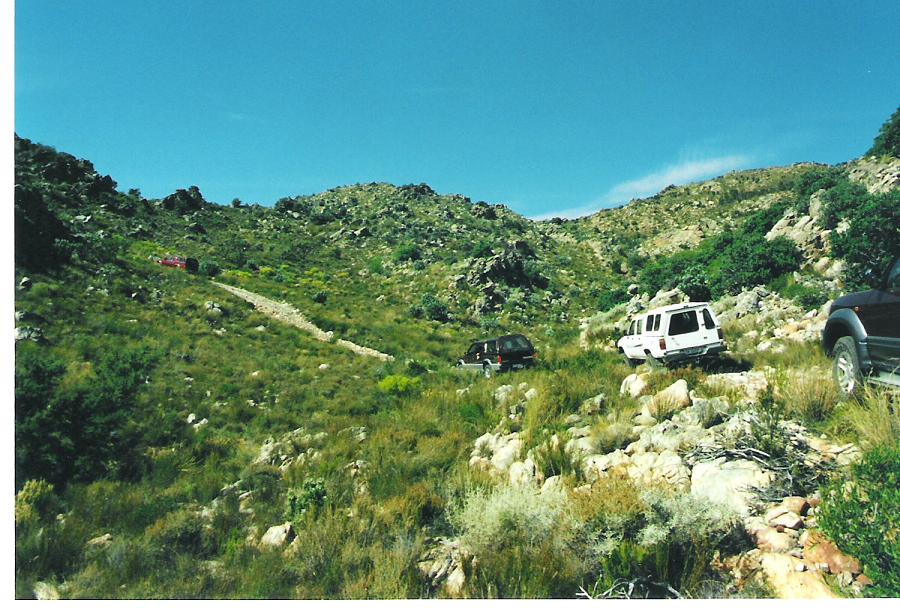
The route renders a variety of driving conditions, giving good exposure to different techniques. When we reach the top, we stop and relax, with sponsored drinks being shared. There is a marked absence of any alcoholic refreshments, which I thought was rather fitting for the occasion.

We proceed again. Shortly thereafter we come to a split in the road. The board says: “Experienced Drivers” with an arrow pointing to the right. I want to aim for the sissy route to the left, but realise that I will be causing virgin tracks on that piece of road. So I turn right. Off to the gallows you go, boet. This brings us to Diepkloof.
In winter this would be a river, but now it is a dry ravine, with very steep banks. From this side the descent is hard sand. Phil positions himself to indicate to drivers which line to take. Because of some axle twisters, the vehicles invariably end up with a front wheel in a hole, with the rear of the vehicles protruding upwards at peculiar angles. Rather impressive, a bit like a Great Dane doing his thing against a tree, you know.

On the other side the very steep ascent requires a slow endeavour in low range second gear. However, adrenalin seems to get the better of some of the drivers and they charge up the bank with screaming engines and spinning wheels. The first two vehicles take the incorrect line, do a bit of a hop & skip, and narrowly miss a bush standing nearby, minding its own business. Phil places a rock as a marker to improve the aim of the next drivers. Keep right of the rock, he instructs.
Eventually it’s my turn. I get in my bakkie, ref the engine, spit through the window, put my camel behind my ear. Then I wind down the window, spit again, this time through the open window. I remove the camel from behind my ear, put it out and put the camel behind my other ear that has not been burnt yet. Then I grab the door with my right elbow……
No, I’m very sorry. I’m lying through my teeth. It did not go exactly like that.
It was more, like, you know, sort of, after slipping away to answer Mother Nature’s rather nervous call, it is my turn. My mouth is dry. Very dry. My hands and knees are shaking. This is, of course, not a bad thing. Given the absence of ABS brakes my shaking right leg works perfectly for cadence braking.
I just do exactly what Phil says. He’s supposed to know what he’s doing, and I decide to simply put my faith blindly in his expertise. Eventually I get down the bank, up with the bank at the other end with the big six grumbling reassuringly, it’s like music. Piece of cake. I nogals felt like a pro, admittedly not due to any particular skills on my side. Arriving on the other side I’m reluctant to let go of my steering wheel. As long as I can clutch the wheel no-one can see the tremor in my hands.

The last difficult leg is a sandy ascent that starts off with a sharp turn to the right, preventing you from picking up a great deal of speed. The very simple principle of letting your tyres down is illustrated sufficiently by the fact that the two vehicles that did not let their tyres down …